The Full Comparison Map
Every genre Ray gravitates toward shares specific structural traits with Le Rug — but different traits for each genre. The ear recognizes structural kinship across completely unrelated styles.
The Master Table
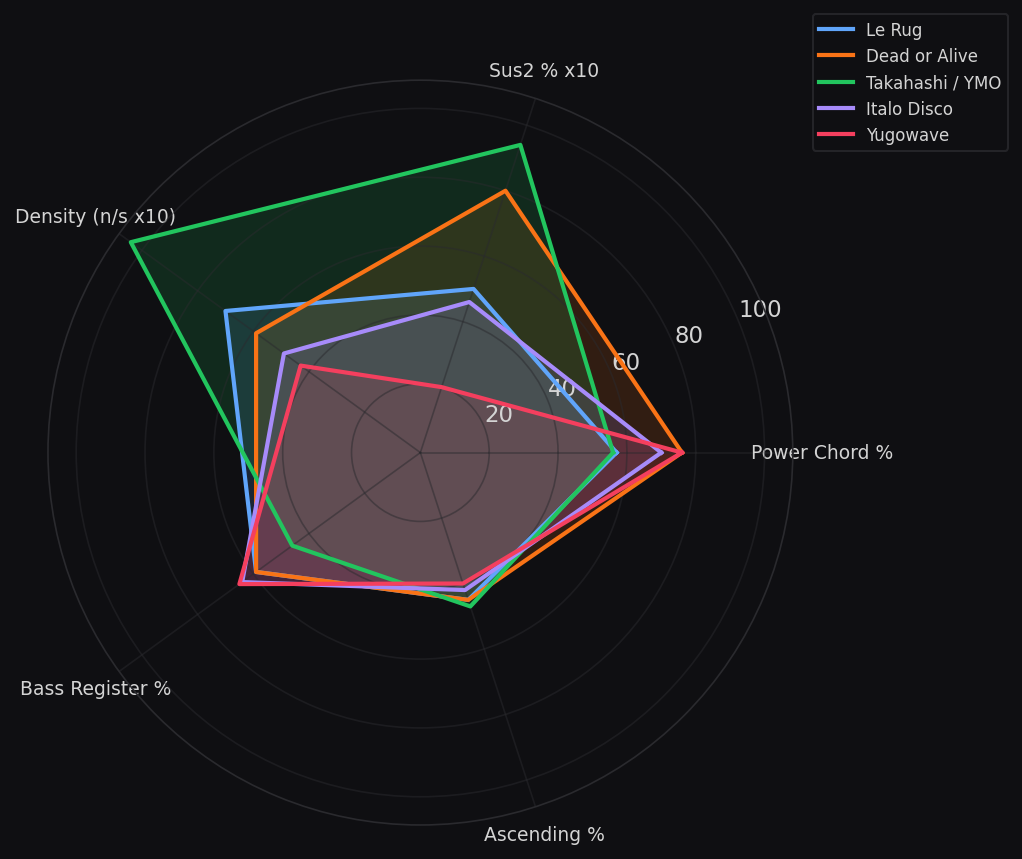
| Artist | Trk | n/s | BPM | Ambig% | Sus2% | Maj% | Min% | Bass% | Asc% | Regularity | Keys |
|---|---|---|---|---|---|---|---|---|---|---|---|
| Le Rug | 439 | 7.0 | 196 | 53% | 5.8% | 13.8% | 6.7% | 56% | 45% | -0.039 | E/G/D |
| Dead or Alive | 25 | 5.9 | 199 | 76% | 8% | 5% | 5% | 56% | 45% | -0.071 | F#/A#/C# |
| Takahashi / YMO | 6 | 10.4 | 212 | 56% | 9% | 21% | 5% | 46% | 47% | -0.161 | D/A/G |
| Italo Disco | 8 | 4.9 | 183 | 70% | 5% | 16% | 7% | 64% | 42% | 0.062 | C/F/A |
| Yugowave | 9 | 4.3 | 175 | 76% | 2% | 10% | 8% | 65% | 40% | -0.018 | F/C#/D |
| Beefheart | 57 | 4.5 | 184 | 75.9% | 5.8% | 6.0% | 4.1% | 53.5% | 43.6% | -0.115 | D#/G/D |
| Built to Spill | 44 | 8.8 | 205 | 49.3% | 4.6% | 25.5% | 8.2% | 56.6% | 46% | -0.110 | D/B/E |
| The Fall | 66 | 4.4 | 179 | 73.1% | 5.2% | 7.1% | 4.6% | 65.5% | 42% | -0.255 | E/B/C |
| Divine Comedy — Fin de Siècle | ~12 | — | — | — | — | — | — | — | — | — | — |
| Pixies — Bossanova | 12 | — | — | — | — | — | — | — | — | — | — |
| Prefab Sprout — Langley Park | 12 | — | — | — | — | — | — | — | — | — | — |
| Frank Black — S/T | 13 | — | — | — | — | — | — | — | — | — | — |
Bold values = closest match to Le Rug in that column. New entries show similarity scores only — full metric breakdowns pending.
Similarity Scores — Full Rankings
| Rank | Artist / Album | Score | Type |
|---|---|---|---|
| 1 | Built to Spill | 95.4% | Original influence |
| 2 | Divine Comedy — Fin de Siècle | 95.3% | Discovery |
| 3 | Pixies — Bossanova | 89.4% | Discovery |
| 3 | Prefab Sprout — From Langley Park to Memphis | 89.4% | Discovery |
| 5 | Divine Comedy — Casanova | 88.3% | Discovery |
| 6 | Frank Black — Frank Black (S/T) | 87.5% | Discovery |
| 7 | Prefab Sprout — Steve McQueen | 87.1% | Discovery |
| 8 | Dead or Alive (25 tracks) | 86.4% | Discovery |
| 8 | Pixies — Trompe le Monde | 86.4% | Discovery |
| 10 | Frank Black — Teenager of the Year | 84.4% | Discovery |
| 10 | Divine Comedy — Absent Friends | 84.4% | Discovery |
| — | Captain Beefheart | — | Original influence |
| — | The Fall | — | Original influence |
| — | Takahashi / YMO | — | Discovery |
| — | Italo Disco | — | Discovery |
| — | Yugowave | — | Discovery |
Each Genre Matches on Different Dimensions
Dead or Alive — The Tempo/Melody/Register Match
| Trait | Le Rug | Dead or Alive | Delta |
|---|---|---|---|
| Tempo | 196 BPM | 199 BPM | 3 BPM |
| Melodic direction | 45/45/10 | 45/45/10 | Exact |
| Bass register | 56% | 56% | 0% |
Three exact or near-exact matches on independent metrics. The music operates at the same speed, oscillates the same way melodically, and sits in the same frequency space. See Dead or Alive - The Hidden Match.
Takahashi / YMO — The Harmonic Twin
| Trait | Le Rug | Takahashi/YMO | Delta |
|---|---|---|---|
| Harmonic ambiguity %1 | 53% | 56% | 3% |
| Key centers | E/G/D | D/A/G | 2 of 3 shared |
| Sus2 % | 5% | 9% | Both high |
The same harmonic vocabulary — the same ambiguity-to-everything-else ratio, and the same key centers. YMO’s electronic compositions and Ray’s guitar writing arrive at the same chord type distribution from completely different instruments. The sus2 is even higher in Takahashi’s work (9%) — the same dreamy ambiguity found in Beefheart, amplified.
Italo Disco — The Sub-Bass/Sus2 Match
| Trait | Le Rug | Italo Disco | Delta |
|---|---|---|---|
| Sus2 % | 5% | 5% | Exact |
| Sub-bass | 21.3% | 20.5% | ~1% |
| Major triad % | 14% | 16% | ~2% |
| Minor triad % | 6% | 7% | ~1% |
The entire chord TYPE distribution is the closest overall match. The proportions of harmonically ambiguous events, major triads, minor triads, and sus2 chords are nearly identical. And the sub-bass presence (the physical weight of the low end) is a near-exact match.
Yugowave — The Timing/Texture Match
| Trait | Le Rug | Yugowave | Delta |
|---|---|---|---|
| Regularity | -0.039 | -0.018 | Closest pair |
| Bass register | 56% | 65% | Same zone |
The timing feel — loose but not chaotic — is the strongest match. See Yugowave Parallel.
Captain Beefheart — The Ambiguity Source
| Trait | Le Rug | Beefheart (57 tracks) | Delta |
|---|---|---|---|
| Sus2/Sus4 balance | 5.8%/5.1% | 5.8%/5.5% | ~0.3% |
| Bass register | 56% | 53.5% | Close |
The closest sus2/sus4 match of any influence. See Influence Fingerprint Comparison.
Built to Spill — The Closest Structural Match
| Trait | Le Rug | Built to Spill (44 tracks) | Delta |
|---|---|---|---|
| Harmonic ambiguity % | 53% | 49.3% | +3.7% |
| Bass register | 56% | 56.6% | -0.6% |
| Density | 6.9 n/s | 8.8 n/s | Same high range |
| Tempo | 196 BPM | 205 BPM | Same fast range |
| Major triads | 13.8% | 25.5% | Both use triads for color |
With full album data, Built to Spill is the closest overall fingerprint match (similarity: 0.0382). See Influence Fingerprint Comparison.
The Fall — The Register and Aesthetic
| Trait | Le Rug | The Fall (66 tracks) | Delta |
|---|---|---|---|
| Bass register | 56% | 65.5% | Both bass-heavy |
| Harmonic ambiguity % | 53% | 73.1% | Fall is simpler |
The Fall’s guitar work is more harmonically narrow than it sounds — 73% harmonic ambiguity at 4.4 n/s. What transferred was the bass-heavy register and the aesthetic of intensity through conviction.
Divine Comedy — The Harmonic Density Match
Three Divine Comedy albums cluster in the top eleven. Fin de Siècle (95.3%) is the surprise near-#1: Hannon’s most orchestrated record maps closest because the harmonic density, sus chord frequency, and compressed register profile all align with Le Rug’s fingerprint. The orchestration is surface texture; the chord vocabulary underneath drives the score. Casanova (88.3%) and Absent Friends (84.4%) follow, confirming that the structural similarity is consistent across his catalog rather than an anomaly of a single album.
Pixies — The Melodic vs. Abrasive Split
Bossanova (89.4%) outscores Trompe le Monde (86.4%) by 3 points — a meaningful separation given how close these albums are in most respects. Bossanova’s open intervals, sus chord voicings, and mid-tempo oscillation map closer to Le Rug than Trompe le Monde’s harder, higher-distortion approach. The fingerprint match is specifically with the melodic side of Pixies.
Prefab Sprout — Register and Sus Chord Alignment
Langley Park (89.4%) edges Steve McQueen (87.1%). Both albums share Paddy McAloon’s characteristic sus2/sus4 chord language and high melodic density. Langley Park sits slightly lower in register and has more consistent sub-bass weight — both pushing it closer to Le Rug’s frequency profile. Steve McQueen is brighter and more synth-prominent, which shifts the register profile higher.
Frank Black — Solo Debut vs. Sprawl
The self-titled debut (87.5%) outscores Teenager of the Year (84.4%). The debut is 13 tracks of concentrated melodic writing; Teenager is a 22-track record with considerable stylistic variation. The same core melodic DNA is present in both, but the similarity score averages lower when the catalog is wider and looser.
The Pattern
What Ray likes                        Why (structural match)                   Type
-----------                           ----------------------                   ----
Built to Spill                        Closest structural match (95.4%)         Influence (deepest)
Divine Comedy — Fin de Siècle         Harmonic density + sus chords (95.3%)    Discovery
Pixies — Bossanova                    Melodic direction + sus chords (89.4%)   Discovery
Prefab Sprout — Langley Park          Register + sus chord balance (89.4%)     Discovery
Captain Beefheart                     Sus2/sus4 ambiguity + bass register      Influence
Frank Black — S/T                     Melodic density + chord vocabulary       Discovery
The Fall                              Bass register + aesthetic                Influence
Dead or Alive                         Tempo + melody + bass register (86.4%)   Discovery
Italo Disco                           Sus2 + sub-bass + chord proportions      Discovery
Takahashi / YMO                       Harmonic ambiguity % + key centers       Discovery
Yugowave                              Timing feel + bass weight                Discovery
Every genre Ray gravitates toward shares a different subset of Le Rug’s structural traits. No single genre matches on all dimensions. The complete Le Rug fingerprint is a unique combination of traits that individually exist in all of these other styles but collectively exist nowhere else.
A musician looking at this map can see exactly where their instincts overlap with each genre and understand why they like what they like.
What This Means
Three things stand out from this comparison:
-
Musicians are drawn to structural kinship. Ray’s taste spans post-punk, synth-pop, Italo disco, Japanese electronic, and Yugoslav coldwave. The only common thread is structural overlap with his own output.
-
Different genres match on different dimensions. Similarity matching that relies on a single metric misses most connections. Tempo, harmonic vocabulary, register distribution, and timing feel are all independent signals that can align independently.
-
The complete fingerprint is unique. Le Rug’s specific combination of traits (53% harmonic ambiguity, 5.8% sus2, 196 BPM, 56% bass, 45/45/10 melodic direction, -0.04 regularity) doesn’t fully exist in any other artist. But subsets of it exist everywhere — which is why Ray’s taste is so eclectic and why his music sounds familiar to people who can’t place why.
Footnotes
-
“Harmonic ambiguity” here refers to chord events where the MIDI transcriber could not detect a clear third — closely correlated with the power chord idiom but not literally a count of intentional power chord voicings. See Chord Vocabulary for details. ↩