Yugowave — The Parallel Convergence
Not an influence. A discovery. Ray found Yugoslav new wave/post-punk/coldwave (1983-1990) and felt an immediate familiarity he couldn’t explain. The data explains it.
The Comparison
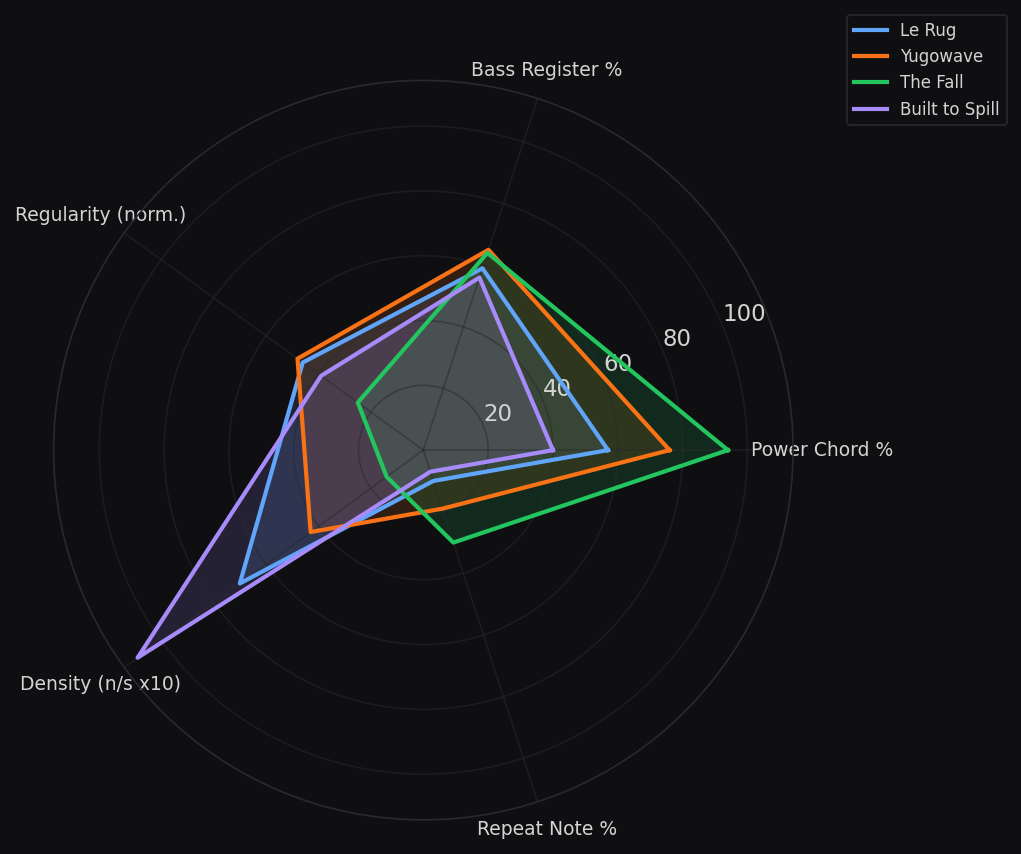
Regularity normalized to 0-50 scale for visual comparison (higher = more metronomic).
| Artist | Tracks | n/s | BPM | Ambig % | Sus2 % | Major % | Minor % | Bass % | Regularity |
|---|---|---|---|---|---|---|---|---|---|
| Le Rug | 439 | 7.0 | 196 | 53% | 5.8% | 13.8% | 6.7% | 56% | -0.039 |
| Yugowave | 9 | 4.3 | 175 | 76% | 2% | 10% | 8% | 65% | -0.018 |
| The Fall | 66 | 4.4 | 179 | 73.1% | 5.2% | 7.1% | 4.6% | 65.5% | -0.255 |
| Built to Spill | 44 | 8.8 | 205 | 49.3% | 4.6% | 25.5% | 8.2% | 56.6% | -0.110 |
| Beefheart | 57 | 4.5 | 184 | 75.9% | 5.8% | 6.0% | 4.1% | 53.5% | -0.115 |
Where It Matches: Texture, Not Composition
The Yugowave fingerprint doesn’t match Le Rug in chord vocabulary (76% harmonic ambiguity vs 53%)1, tempo (175 vs 196 BPM), or density (4.3 vs 6.9 n/s). By the compositional metrics, they’re quite different.
But by the textural metrics — the ones that describe how the music feels rather than what notes are played — they’re the closest match:
1. Rhythmic Regularity: Closest Match of Any Group
| Artist | Regularity | Description |
|---|---|---|
| Yugowave | -0.018 | Loose but controlled |
| Le Rug | -0.039 | Loose but controlled |
| Beefheart | -0.115 | Notably loose |
| Built to Spill | -0.110 | Notably loose |
| The Fall | -0.255 | Deliberately chaotic |
Le Rug and Yugowave are the two closest-to-zero regularity scores in the comparison. Both play “loose but not chaotic” — there’s a pulse you can feel but it’s not metronomic. The Fall is much more wild; BtS and Beefheart are in between. This timing feel is what creates the “alive” quality in both Le Rug and Yugowave — the slight human inconsistency that makes the music breathe.
2. Bass-Heavy Register: Heaviest Match
| Artist | Bass + Sub-bass |
|---|---|
| The Fall | 65.5% |
| Yugowave | 65% |
| Built to Spill | 56.6% |
| Le Rug | 56% |
| Beefheart | 53.5% |
Yugowave is the most bass-heavy group in the comparison — even more than The Fall. Le Rug is close behind. Both sit in the same low-frequency zone. The music occupies the same sonic space physically.
3. Sub-bass Presence
Le Rug: 21.3%, Yugowave: 24.6%. Both use significantly more sub-bass than BtS (15.7%) or The Fall (11.3%). The rumble is a shared characteristic.
4. Mid-Register Balance
Le Rug: 11.6%, Yugowave: 10.4%. Nearly identical mid-register usage. Both use the mid-range sparingly and for the same proportion.
Where It Doesn’t Match: The Tools Are Different
The Yugowave bands are slower (175 BPM), sparser (4.3 n/s), higher in harmonic ambiguity (76%), use more note repetition (19% vs 10%), and sit in darker key centers (F, C#, D vs E, G, D). They have almost no sus2 usage (1.9% vs 5%) — so the Beefheart-derived sus-chord color is absent.
These are musicians from a completely different tradition (Yugoslav pop culture, European new wave/coldwave) arriving at a similar texture through different technique. They use more power chords and fewer extensions, but the overall sound — bass-heavy, loosely timed, dark, post-punk energy — overlaps with Le Rug.
What Ray Is Hearing
When Ray says “this sounds extremely similar to what I already do,” he’s responding to texture, not theory:
- The bass weight
- The timing feel (loose but not sloppy)
- The dark, post-punk atmosphere
- The guitar-as-texture approach (dense low-end wash rather than clean melodic lines)
The chord vocabulary and tempo are different enough that a genre-based approach would never surface this connection. But looking at register distribution, rhythmic regularity, and sub-bass presence catches it immediately.
The parallel is in how the music sits in the room, not what notes are being played.
Tracks Analyzed
| Track | Artist | Year | Genre Tag |
|---|---|---|---|
| Na Zapadu Nista Novo | Boomerang | ~1980s | New wave |
| Kafe Na Dnu Okeana | Boye | 1983 | New wave / dark synth / post-punk |
| Lola | Krik | 1986 | Dark romantics / alter pop |
| Za Tebe | La Card | 1984 | Electro synth |
| Put | Morbidi I Mnoci | 1987 | Goth rock / darkwave / coldwave |
| Tisina | Romantine Boje | 1986 | Coldwave |
| To Nisam Vise Ja | Trivalia | 1987 | Old school goth rock |
| Detektivska Prica | Videosex | ~1980s | New wave |
| Danas | Inje | ~1980s | Post-punk |
Footnotes
-
“Harmonic ambiguity” here refers to chord events where the MIDI transcriber could not detect a clear third — closely correlated with the power chord idiom but not literally a count of intentional power chord voicings. See Chord Vocabulary for details. ↩