Modest Mouse — The Chord Vocabulary Home
Modest Mouse is the closest multi-album chord-vocabulary match to Ray Weiss’s catalog in the reference DB. Lonesome Crowded West sits at distance 2.64, rank #4 of 148 entries. Two Modest Mouse albums have sus chord densities within 0.5 percentage points of Ray’s own — the closest sus chord match anywhere in the reference DB. The finding confirms Ray’s own self-reported origin story: Modest Mouse is the foundation chord vocabulary from pre-teen and teen formation, with jazz-chord extensions layered on later through formal guitar lessons.
The Data
Ray’s 3-dimensional chord-vocabulary distance (major triad %, minor triad %, sus combined %) against the 148-entry reference DB puts the four Modest Mouse full-length albums at the following approximate ranks:
| Album | Rank | 3-dim Distance | Sus % | Major % | Minor % |
|---|---|---|---|---|---|
| Lonesome Crowded West (1997) | #4 | 2.64 | 10.4 | 15.9 | 8.2 |
| Moon & Antarctica (2000) | #18 | 5.83 | 16.6 | 14.7 | 5.5 |
| Good News for People Who Love Bad News (2004) | ~#22 | ~6.60 | 7.4 | 19.4 | 6.3 |
| Building Nothing Out of Something (1999) | ~#40 | ~8.80 | 10.5 | 21.5 | 2.5 |
| Ray Weiss (reference catalog) | — | 0 | 10.9 | 13.8 | 6.7 |
The rank #4 sits inside an unusually tight top of the ranking. The difference between #1 (Prefab Sprout — Steve McQueen at 1.69) and #4 (Modest Mouse — Lonesome Crowded West at 2.64) is less than one distance unit. Four Modest Mouse albums all sit among the 50 closest chord-vocabulary neighbors in the entire reference DB.
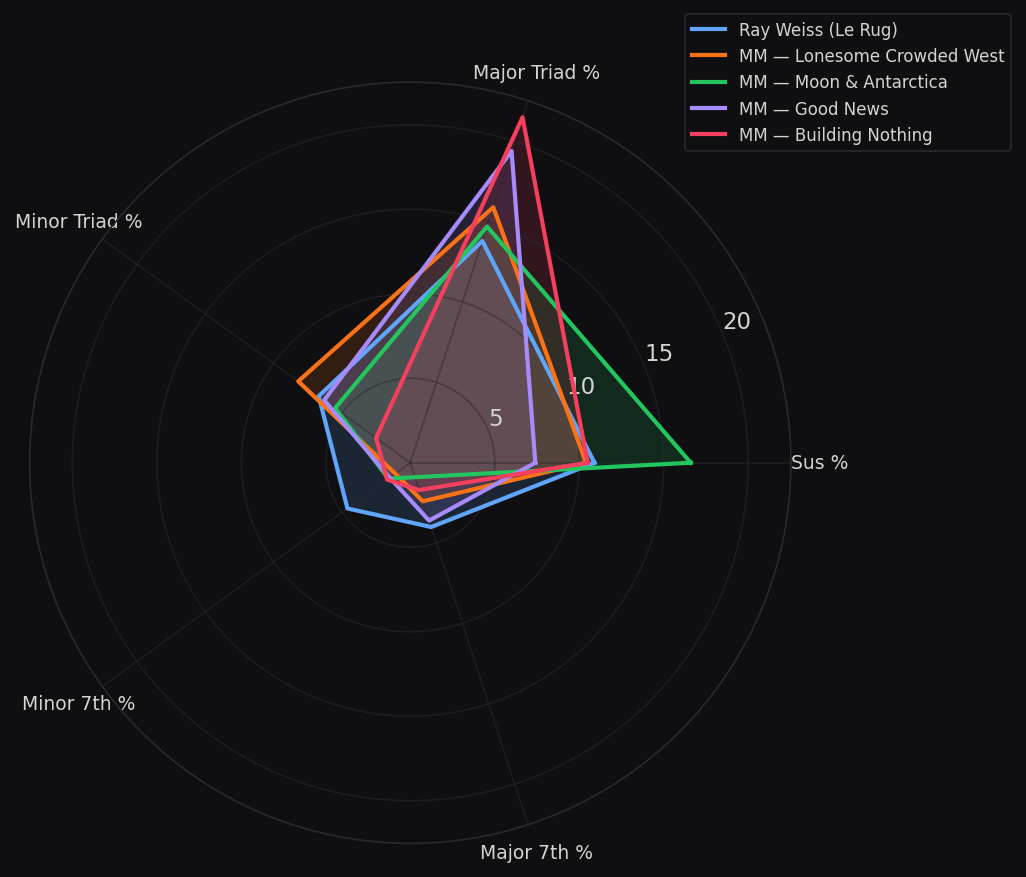
Four Modest Mouse albums tracing roughly the same shape on the first three axes, all surrounding Ray’s profile. On the minor 7th and major 7th axes, Ray’s line rises cleanly above all four. That divergence is the point, and has a specific explanation below.
The atomic sus match
| Catalog | Sus (combined) | Delta vs Ray |
|---|---|---|
| Ray Weiss | 10.9% | — |
| MM — Building Nothing | 10.46% | 0.44 pp |
| MM — Lonesome Crowded West | 10.40% | 0.50 pp |
| Bowie — Low | 11.9% | 1.0 pp |
| Pavement — Slanted & Enchanted | 11.9% | 1.0 pp |
| Prefab Sprout — Steve McQueen | 12.1% | 1.2 pp |
| Frank Black — S/T | 12.1% | 1.2 pp |
Two Modest Mouse albums are within half a percentage point of Ray’s own sus chord density. No other entry in the 148-entry reference DB is closer. Building Nothing Out of Something at 10.46% is the single closest sus match anywhere in the database.
Sus chords — sus2 and sus4 combined — are a chord-vocabulary signature, not a stylistic accessory. They mark a composer comfortable leaving harmony unresolved, letting the 2nd or 4th ring without the ear’s expected third. On guitar, sus voicings come from removing a finger from a standard open chord and letting an adjacent open string fill the gap. It’s the Johnny Marr idiom, the Sonic Youth idiom, the Built to Spill idiom, and by the measure of this data, the Modest Mouse idiom and the Ray Weiss idiom at nearly indistinguishable rates.
Why This Lands
The major and minor triad neighborhood
Ray plays major triads at 13.8% and minor triads at 6.7%. The four Modest Mouse albums average 17.9% major and 5.7% minor. Ray sits slightly lower on majors across the cluster and roughly matches on minors. The two-to-one to three-to-one major-to-minor ratio is consistent across all five catalogs. The direction is the same even when the absolute numbers drift.
The modal character
Modest Mouse is a modal-heavy band by the tool’s measure. Lonesome Crowded West’s scale_modal_pct is 40%. Moon & Antarctica is also 40%. Good News is 56%. Building Nothing is 58%. Four-album average: 48.6% modal. Ray’s catalog registers high modal ambiguity in a similar register. Neither catalog plays clean major-scale pop. Both wander through modes without committing to one tonic for long.
The tempo neighborhood
Ray’s tempo_mean_normalized sits around 0.73. The four Modest Mouse albums cluster at 0.72, 0.76, 0.77, 0.78, averaging 0.76. Roughly the same fundamental speed. This isn’t driving the chord-vocabulary distance directly, but it confirms the two catalogs inhabit the same rhythmic register in addition to the same harmonic vocabulary. The match isn’t only in chord types; it’s also in the pacing the chords move at.
The Divergence — Jazz Extensions
The one axis where Ray breaks cleanly from the Modest Mouse cluster is extended chords.
| Chord Type | Ray | MM 4-album avg | Delta |
|---|---|---|---|
| Minor 7th | 4.6% | 1.48% | +3.1 pp |
| Major 7th | 4.0% | 2.17% | +1.8 pp |
Ray uses roughly three times more minor 7ths and nearly twice as many major 7ths as Modest Mouse does. These are not small differences. Minor 7ths and major 7ths are full chord types with their own voicings and harmonic function, not dimensional grace notes. If Modest Mouse is the foundation chord vocabulary, the extended chords are something Ray added on top.
Ray’s own account of where the extended chords come from: a high school classmate taught him Wes Montgomery’s “Four on Six” and basic jazz chords — minor 7ths, major 7ths, sus chords, extensions. Separately, formal guitar lessons with Jesse Harris, later a Grammy-winning producer and songwriter on Norah Jones’s Come Away With Me. This is a pedagogical lineage distinct from the listening-based absorption that gave Ray the Modest Mouse cluster shape. The formation chord vocabulary is structural rip-off material. The extension layer is taught.
The fingerprint captures both. The Modest Mouse cluster is the foundation: sus density, major/minor triad balance, modal character. The min7 and maj7 elevation above the cluster is the Jesse Harris and Wes Montgomery lineage crystallized as measurable harmonic surface. Two different origin stories for two different layers of Ray’s chord vocabulary, and the fingerprint separates them cleanly.
Context — Ray’s Own Account
In a 2026-04-14 interactive session, after being shown the chord-vocabulary ranking, Ray’s integration was direct:
“Right around with [Modest Mouse] is when I started really getting into music and many of my first attempts at bands were just straight ripping them off so all of that lands cleanly I think.”
The self-reported rip-off source material came up as one of the tool’s tightest chord-vocabulary matches — not coincidentally, but mathematically. The finding is exactly the kind of result the honest findings philosophy is built to produce: the tool confirmed what Ray suspected, and the atomic sus-chord match sharpened the claim from “I think I was influenced by them” to “my chord density and their chord density are structurally indistinguishable on the most signature axis of my vocabulary, and on this axis no other entry in a 148-entry database is closer.”
Modest Mouse is not the only chord-vocabulary neighbor. Prefab Sprout — Steve McQueen sits at distance 1.69, the tightest full-album match in the reference DB. Kate Bush — Hounds of Love sits at #2 at 2.26, a genuine surprise that is not in Ray’s stated influences. Bowie — Low at #5 and Station to Station at #6 form a tight 1976-77 Berlin-era cluster. These are Ray’s chord-vocabulary neighbors more broadly, documented individually in their own Theory pages. But Modest Mouse is the cluster Ray named directly as the rip-off source, and the cluster the tool confirmed with the tightest sus-chord match in the entire reference DB.
What This Case Study Does NOT Show
Built to Spill is not in Ray’s chord-vocabulary top twenty. BTS sits considerably further on the chord-vocabulary axis than Modest Mouse. But BTS is confirmed elsewhere as Ray’s rhythm, melody, and register match (see Influence Fingerprint Comparison). The point of this case study is to be specific about which axis the Modest Mouse match operates on. Modest Mouse is the chord vocabulary home. Built to Spill is the rhythm and melody home. They are different dimensions of formation, and the tool separates them cleanly.
Similarly, The Fall — Ray’s canonical stated number-one influence — sits at a looser chord-vocabulary distance than Modest Mouse. The structural influence from The Fall is on register, tonal wandering, and double-drum feel (documented elsewhere in Influence Fingerprint Comparison), not on the chord vocabulary itself. Ray’s own integration: the Fall influence was attitudinal and structural in non-chord dimensions, while the chord vocabulary came from other places.
The fingerprint’s clean separation of these axes — rhythm, chord vocabulary, melody, register — is what allows this kind of specific attribution. A coarser recommendation system would see “indie rock neighbor” as a single dimension and put Modest Mouse, Built to Spill, The Fall, and Pavement in the same bucket. This analysis separates them into different rooms of the same house.
Tracks Analyzed
15 tracks from The Lonesome Crowded West (1997), 15 tracks from The Moon & Antarctica (2000), 16 tracks from Good News for People Who Love Bad News (2004), and 12 tracks from Building Nothing Out of Something (1999). Fifty-eight tracks total across the four-album cluster. All sourced from YouTube Music canonical OLAK5uy_ topic playlists. Analysis pipeline: basic-pitch MIDI extraction, music21 harmony enrichment, per-album fingerprint aggregation, 3-dimensional chord-vocabulary distance computation against the 148-entry reference DB as of 2026-04-15.
Related case studies in this vault: Prefab Sprout — Steve McQueen (the current #1 at 1.69, another stated influence confirmed), Kate Bush — Hounds of Love (the #2 surprise, pending ear validation), Bowie — Low (self-recognition hypothesis validation via within-album side split). All four are part of the broader chord-vocabulary ranking at The Full Comparison Map.