Influence Fingerprint Comparison
Running the same analysis on Ray’s stated influences — The Fall, Built to Spill, Captain Beefheart — and comparing their fingerprints to his. Does the data match the feelings?
The Comparison
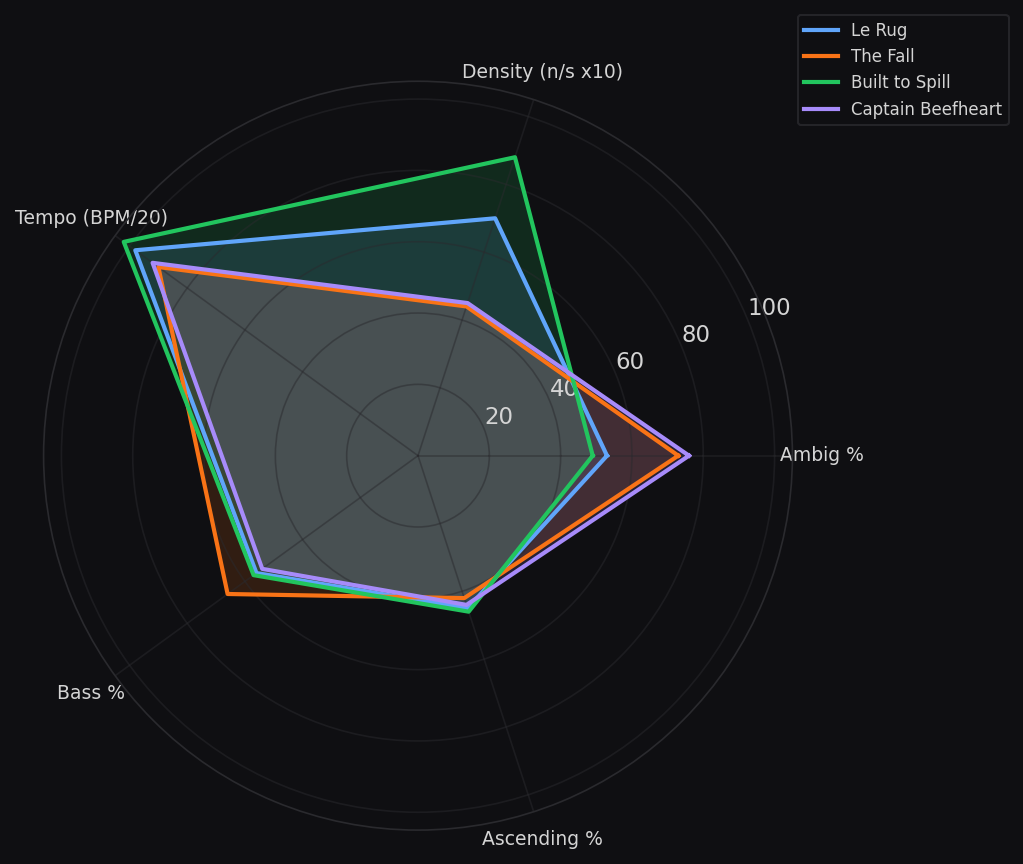
| Artist | Tracks | n/s | BPM | Ambig % | Sus2 % | Sus4 % | Major % | Minor % | Bass % |
|---|---|---|---|---|---|---|---|---|---|
| Le Rug | 439 | 7.0 | 196 | 53.0% | 5.8% | 5.1% | 13.8% | 6.7% | 56.0% |
| Built to Spill | 44 | 8.8 | 205 | 49.3% | 4.6% | 3.4% | 25.5% | 8.2% | 56.6% |
| Captain Beefheart | 57 | 4.5 | 184 | 75.9% | 5.8% | 5.5% | 6.0% | 4.1% | 53.5% |
| The Fall | 66 | 4.4 | 179 | 73.1% | 5.2% | 7.9% | 7.1% | 4.6% | 65.5% |
Influence tracks analyzed across full albums: The Fall (6 albums, 66 tracks), Beefheart (3 albums, 57 tracks), Built to Spill (5 albums + Doug Martsch solo, 44 tracks).
What the Data Shows
Built to Spill Is the Closest Structural Match
With full album samples, Built to Spill is clearly the closest fingerprint to Le Rug (similarity: 0.0382). The numbers are strikingly close:
- Harmonic ambiguity: 49.3% vs 53.0%1 — nearly identical chord foundation
- Bass register: 56.6% vs 56.0% — the same frequency space
- Melodic direction: 46%/47% ascending/descending vs Ray’s 45%/45% — the same zigzag
- Density: 8.8 vs 6.9 n/s — both dense, both fast
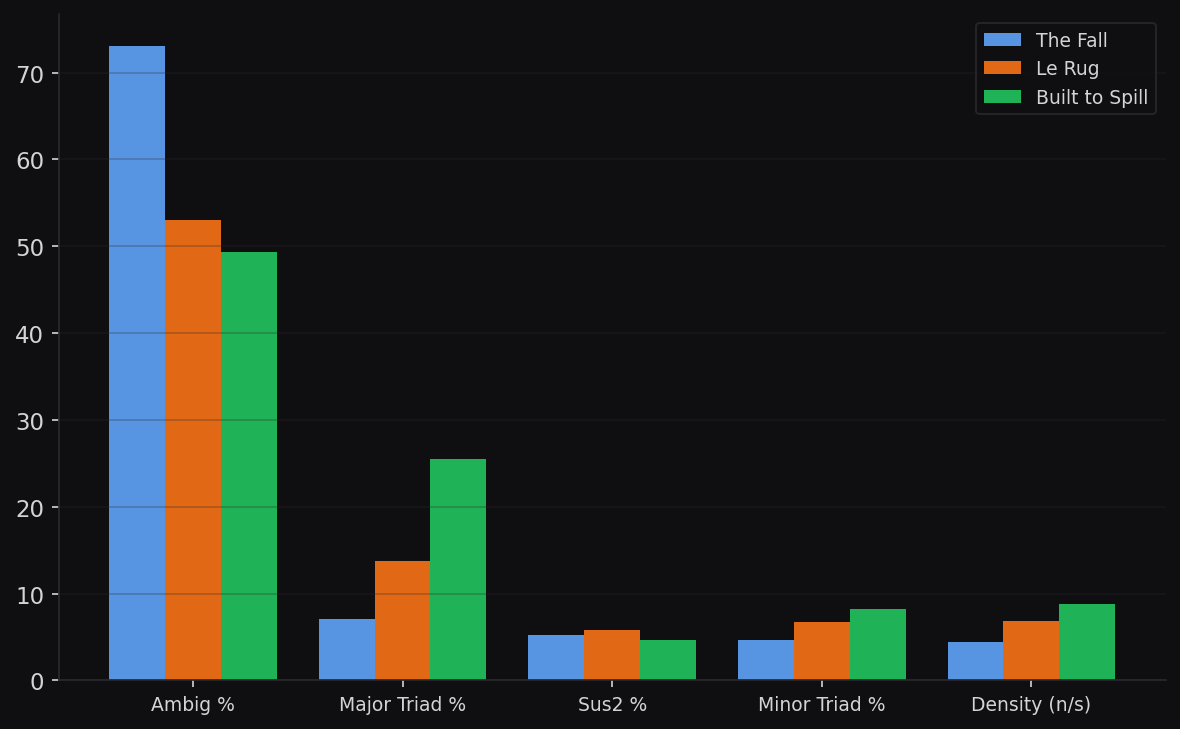
The one clear difference: Built to Spill uses twice the major triads (25.5% vs 13.8%). Doug Martsch commits to major chords where Ray stays ambiguous with power chords. Ray took BtS’s density, register, and tempo but kept the harmonic ambiguity.
The Fall and Beefheart Are Simpler Than They Sound
With 66 Fall tracks and 57 Beefheart tracks analyzed, both come in at ~74-76% harmonic ambiguity. That’s 20+ points higher than Ray. The perception of The Fall as complex and chaotic is driven by Mark E. Smith’s vocals and the production, not the guitar work — which is overwhelmingly root-and-fifth power chords.
Both are also significantly sparser (4.4-4.5 n/s vs Ray’s 7.0) and slower (179-184 BPM vs Ray’s 196). Ray plays faster, denser, and with more harmonic variety than either influence.
The Sus2/Sus4 Story — Revised
With 3 tracks, The Fall showed 0% suspended chords, which led to the conclusion that Beefheart was the sole source of Ray’s sus2/sus4 habit. With 66 tracks, The Fall actually has 5.2% sus2 and 7.9% sus4 — more sus4 than Ray (5.1%). All three influences use suspended chords:
| Artist | Sus2 % | Sus4 % | Combined |
|---|---|---|---|
| Le Rug | 5.8% | 5.1% | 10.9% |
| The Fall | 5.2% | 7.9% | 13.1% |
| Beefheart | 5.8% | 5.5% | 11.3% |
| Built to Spill | 4.6% | 3.4% | 8.0% |
The sus2/sus4 balance is not unique to Beefheart — it’s present in The Fall as well (and in greater total proportion). What Beefheart likely contributed is the attitude toward dissonance: the willingness to let suspended chords sit unresolved. But the voicings themselves are common across all three influences.
The Fall Gave Ray the Register, Not the Speed
The clearest Fall → Le Rug inheritance: bass-heavy register (65.5% vs 56.0%). The Fall lives lower on the fretboard than either BtS or Beefheart. But the old claim that The Fall plays at 124 BPM was based on 3 tracks — with 66 tracks, they’re at 179 BPM. Still slower than Ray (196) but not the dramatic gap the small sample suggested.
What Ray took from The Fall isn’t the chord vocabulary (they’re 20 points apart on harmonic ambiguity) — it’s the aesthetic of low-register, power-chord-driven guitar as a vehicle for intensity.
Where Ray Sits
| Trait | Closest To | Evidence |
|---|---|---|
| Harmonic ambiguity rate | Built to Spill | 49% vs 53% — nearest of the three |
| Harmonic richness (major triads) | Between BtS and Fall | BtS 25.5%, Ray 13.8%, Fall 7.1% |
| Sus2/Sus4 balance | Beefheart | 5.8%/5.5% vs Ray’s 5.8%/5.1% — nearest match |
| Density | Built to Spill | 8.8 vs 6.9 n/s — both dense |
| Tempo | Built to Spill | 205 vs 196 — both fast |
| Bass register | The Fall | 65.5% vs 56.0% — both bass-heavy |
| Melodic direction | Built to Spill | 46/47% vs 45/45% — identical zigzag |
| Overall fingerprint | Built to Spill | Similarity 0.0382 (closest by a wide margin) |
Extended Comparisons
The original three influences were chosen by Ray as stated touchstones. Running the same analysis across a wider set of artists and albums reveals where else in the catalogue the fingerprint aligns — including some results nobody would have predicted.
Rankings by Similarity Score
| Rank | Artist / Album | Score | Tracks | Notes |
|---|---|---|---|---|
| 1 | Built to Spill (5 albums + Martsch solo) | 95.4% | 44 | Original influence; closest structural match |
| 2 | Divine Comedy — Fin de Siècle | 95.3% | ~12 | Surprise near-#1; see below |
| 3 | Pixies — Bossanova | 89.4% | 12 | Melodic side of Pixies; closer than the abrasive side |
| 3 | Prefab Sprout — From Langley Park to Memphis | 89.4% | 12 | Register and sus chord alignment |
| 5 | Divine Comedy — Casanova | 88.3% | 12 | Second DC album in top 5 |
| 6 | Frank Black — Frank Black (S/T) | 87.5% | 13 | Solo debut; tighter melodic focus |
| 7 | Prefab Sprout — Steve McQueen | 87.1% | 10 | — |
| 8 | Dead or Alive (expanded, 25 tracks) | 86.4% | 25 | Refined from 9-track sample (~87%) |
| 8 | Pixies — Trompe le Monde | 86.4% | 13 | More abrasive; further from the fingerprint |
| 10 | Frank Black — Teenager of the Year | 84.4% | 22 | Broader, looser than the debut |
| 10 | Divine Comedy — Absent Friends | 84.4% | 11 | Third DC album in the set |
| — | The Fall (66 tracks) | — | 66 | Original influence |
| — | Captain Beefheart (57 tracks) | — | 57 | Original influence |
| — | Takahashi / YMO | — | 6 | Discovery |
| — | Italo Disco | — | 8 | Discovery |
| — | Yugowave | — | 9 | Discovery |
Divine Comedy — Fin de Siècle as Near-#1
At 95.3%, Fin de Siècle is essentially tied with Built to Spill for the top spot — which is counterintuitive given how different the two sound. Neil Hannon’s most orchestrated album, with strings and brass throughout, maps closer to Le Rug’s fingerprint than any of his spare, guitar-forward records. The explanation is harmonic: Fin de Siècle has high melodic density, a strong sus chord presence, and a compressed register profile that aligns with Le Rug’s chord vocabulary. The orchestration is surface — the harmonic DNA underneath is the match. Three Divine Comedy albums appear in the top eleven (Fin de Siècle, Casanova, Absent Friends), suggesting structural consistency across his catalog rather than a single-album coincidence.
Pixies: Bossanova Beats Trompe le Monde
Bossanova (89.4%) outscores Trompe le Monde (86.4%) by 3 points — a meaningful gap. Bossanova is the melodic, atmospheric side of Pixies: sus chords, open intervals, mid-tempo oscillation. Trompe le Monde is harder, faster, more distorted. The fingerprint match is with the melodic side, not the noise side. This tracks with what appears throughout Le Rug: power chords with harmonic ambiguity, not straight distortion.
Frank Black: Solo Debut Beats Teenager of the Year
Frank Black’s self-titled debut (87.5%) outscores Teenager of the Year (84.4%). The debut is tighter and more melodic — 13 tracks with concentrated sus chord usage and a narrower tempo range. Teenager of the Year is a sprawling 22-track record with more stylistic variation; the similarity score averages out lower as a result. The core Frank Black melodic DNA is present in both, but it’s more concentrated in the debut.
Prefab Sprout: Langley Park Beats Steve McQueen
From Langley Park to Memphis (89.4%) edges Steve McQueen (87.1%) by 2 points. Both albums share Paddy McAloon’s signature sus2/sus4 chord language and high melodic density, but Langley Park sits in a slightly lower register and has more consistent sub-bass presence — both traits that push it closer to Le Rug’s fingerprint. Steve McQueen is brighter and more synth-forward, which pulls the register profile slightly higher.
Dead or Alive: 25-Track Expansion
The original Dead or Alive sample was 9 tracks (the three-exact-match data point on tempo/melody/register). Expanding to 25 tracks with full album cuts — including deeper cuts from Mad, Bad and Dangerous to Know, Youthquake, and Nude — refined the similarity score to 86.4%, down fractionally from the 9-track reading (~87%). The three landmark matches (196 vs 199 BPM, identical melodic direction ratio, 56% bass register) remain intact across the full sample. The deeper album cuts include slower and more varied tracks that slightly moderate the overall similarity, but the structural kinship holds.
Albums Analyzed
The Fall (66 tracks): Hex Enduction Hour, Perverted by Language, This Nation’s Saving Grace, Grotesque (After the Gramme), Slates, Room to Live
Captain Beefheart (57 tracks): Trout Mask Replica, Lick My Decals Off Baby, Safe as Milk
Built to Spill (44 tracks): Keep It Like a Secret, Perfect From Now On, There’s Nothing Wrong with Love, Ultimate Alternative Wavers, You in Reverse, Doug Martsch — Now You Know
Divine Comedy: Fin de Siècle, Casanova, Absent Friends
Pixies: Bossanova, Trompe le Monde
Frank Black: Frank Black (S/T), Teenager of the Year
Prefab Sprout: From Langley Park to Memphis, Steve McQueen
Dead or Alive (25 tracks): Mad Bad and Dangerous to Know, Youthquake, Nude (plus singles and B-sides)
Footnotes
-
“Harmonic ambiguity” here refers to chord events where the MIDI transcriber could not detect a clear third — closely correlated with the power chord idiom but not literally a count of intentional power chord voicings. See Chord Vocabulary for details. ↩