Your Musical DNA
What the data reveals about how Ray Weiss writes music — the theory behind the ear.
Based on analysis of 439 tracks across Le Rug, Butter the Children, Living Serious, Red Dwarf, Defenestrator, solo releases, recovered live recordings, and unreleased instrumentals — the complete known output.
The Big Picture
You play almost entirely by ear, have no formal theory training, and describe your sound as “an aggressive version of Built to Spill.” The data confirms this description almost perfectly — but also reveals things about your playing that formal theory would call sophisticated, even though you arrived at them instinctively.
1. Your Chord World Lives in Ambiguity
53.0% of your detected chord events are harmonically ambiguous — the analysis can’t pin them as major or minor. This is your foundation. The other 47% is where the harmonic vocabulary gets explicit: major triads, suspensions, 7ths, 9ths.
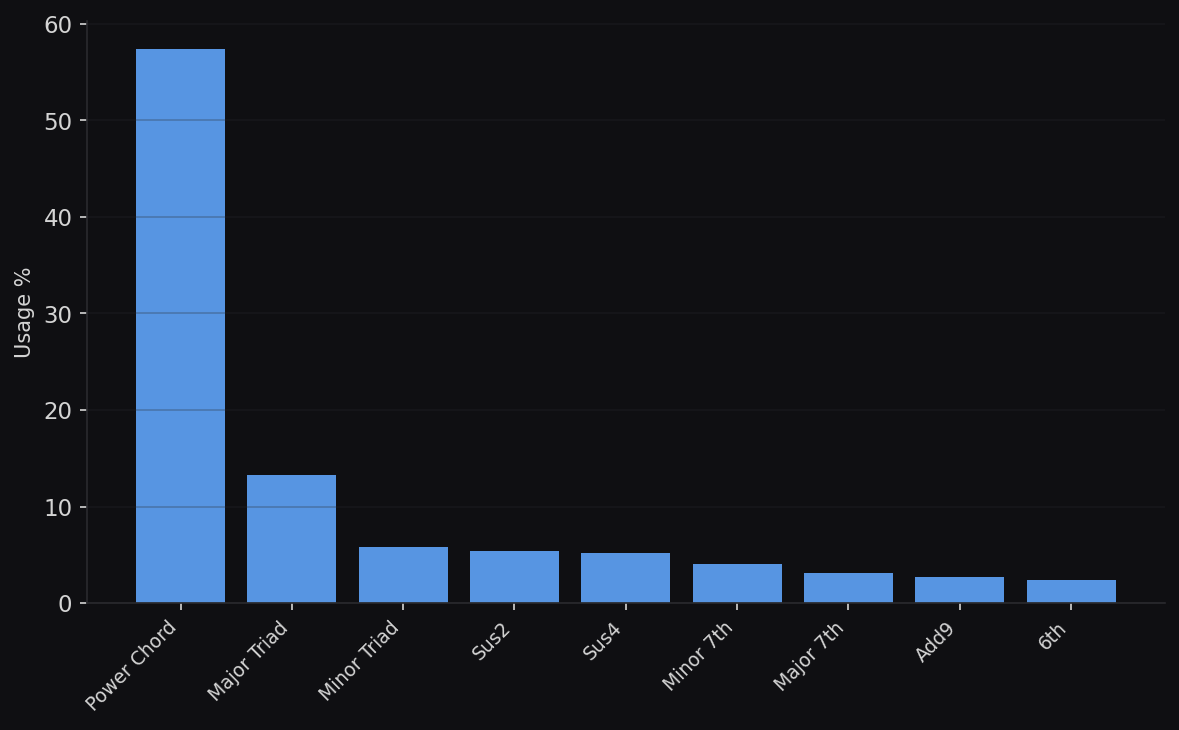
| Chord Type | Usage | What It Means |
|---|---|---|
| Harmonically ambiguous (root+5th detected) | 53.0% | Your backbone — the third is either absent or masked by distortion |
| Major triad | 13.8% | When the third is detectable, you lean major |
| Minor triad | 6.7% | About half as often as major — you’re not a “sad” writer |
| Sus2 | 5.8% | The “open” sound — dreamy, deliberately unresolved |
| Sus4 | 5.1% | The “reaching up” sound — tension without resolution |
| Minor 7th | 4.1% | Jazz-adjacent color — more than most indie guitarists use |
| Major 7th | 3.1% | Shimmer chords — this is the shoegaze influence |
| Add9 | 2.7% | Sophistication you don’t know you have |
| 6th chords | 2.4% | These are unusual for your genre — a personal quirk |
Why “harmonically ambiguous” instead of “power chords”: The 53.0% figure comes from MIDI transcription, which detects audible notes in the recording. When the analyzer can find a root and a 5th but no third, it logs the event as ambiguous. Three things produce this signature:
- Actual root+5th voicings (the canonical power chord shape — root and 5th, no 3rd at all)
- “The Standard” voicing — your default 5-string shape, which is root + 5th + 9th. The 2nd is ringing on the B string but there’s still no 3rd, so the detector reads it as ambiguous.
- Distortion-masked triads — when you’re playing a full major or minor chord through a distorted amp, the 3rd often doesn’t survive the transcription cleanly, so the chord registers as ambiguous even though the third was there in the room.
This is the fingerprint of distorted-guitar style played in standard tuning — and it’s the central feature of how Le Rug sounds. The metric measures an audio signature, not a count of intentional voicings. What matters compositionally isn’t whether you “played a power chord” or “played a triad with a masked 3rd” — it’s that the listener experiences 53% of your chord events as harmonically unresolved. Your music sits in permanent suspension because the audible third is either not there or not loud enough to commit.
The push-pull of explicit suspensions: When the analyzer DOES detect a clear chord type, sus2 and sus4 come in nearly equal — 5.8% vs 5.1%. Most guitarists lean heavily one way. The equal usage creates a constant push-pull: the 2nd wants to resolve down, the 4th wants to resolve up, and neither wins. Combined with the ambiguous 53% baseline, the listener is essentially never on solid harmonic ground.
Your Most-Used Specific Chords
- G5 — your single most played chord shape across all material
- C5 — second most
- D5 — third
- A5 — fourth
- C major triad — your most-used full triad (2,552 instances)
The G-C-D-A-E shape sequence is the backbone of your entire catalog. With the full output counted (not just Le Rug), G and C rise to the top — the non-Le Rug material and solo instrumentals favor brighter, higher key centers that pull the aggregate away from the D-A center of the studio albums alone.
2. The Octave Thing — Your Signature Move
Your #1 most common interval is the octave (12 semitones). Your most common motif is literally:
octave down -> octave up -> octave down (x1958)
octave up -> octave down -> octave up (x1794)
This is the Doug Martsch / Built to Spill technique — playing the same note or melody in multiple octaves simultaneously or in rapid alternation. It creates a thick, shimmering wall of the same pitch class spread across the frequency spectrum.
Why this matters theoretically: Octave doubling doesn’t add harmonic information (it’s the same note), but it dramatically changes the timbre and perceived loudness of a line. You’re essentially using octaves as a textural tool rather than a harmonic one. This is why your music sounds “full” even when the actual harmonic content is simple root+5th voicings.
Your second most common motif: 5th up → 5th down (bouncing between root and fifth). This creates a droning, hypnotic quality — very Fall-influenced.
3. Scale & Mode Analysis — The Chromatic Question
The scale detector flagged 96% of your tracks as “chromatic” — meaning you use all 12 notes with enough frequency that no single scale dominates. This does NOT mean you’re playing random notes. It means:
- You freely mix sharps and flats that wouldn’t coexist in a single key
- You modulate (change key) frequently within songs without thinking about it
- Your guitar voicings use open strings that ring against fretted notes, creating chromatic clashes
This is actually a hallmark of ear-trained guitarists who play in standard tuning. The open E, A, D, G, B, E strings ring sympathetically no matter what chord you’re fretting, adding chromatic color that a theory-trained player would carefully avoid or control.
Your Pitch Class Hierarchy (All Tracks Combined)
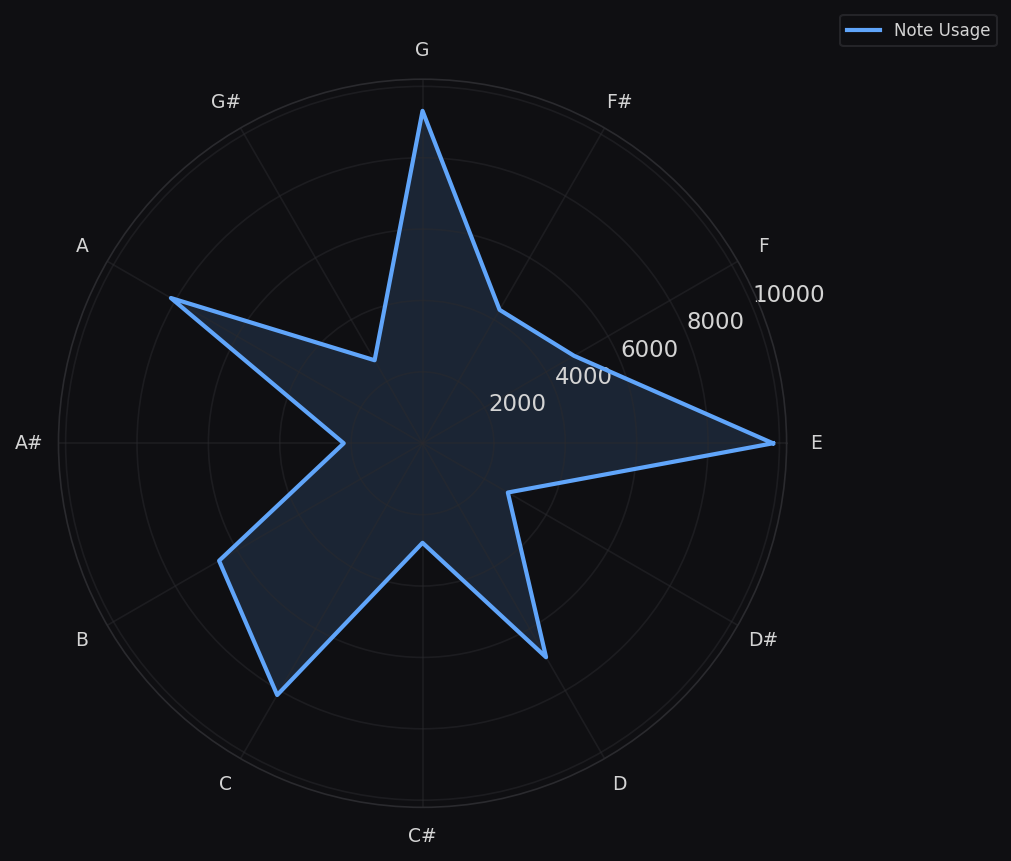
| Pitch | Count | Note |
|---|---|---|
| E | 9,820 | Open low E and high E strings |
| G | 9,315 | Open G string, power chord 3rd fret |
| C | 8,145 | Common in chord shapes |
| A | 8,141 | Open A string |
| D | 6,923 | Open D string |
| B | 6,582 | Open B string |
| F | 4,902 | |
| F# | 4,318 | 2nd fret on low E |
| C# | 2,789 | |
| D# | 2,760 | |
| G# | 2,686 | |
| A# | 2,208 | Least used |
Notice something? Your top 6 pitch classes are exactly the 6 open strings of a guitar in standard tuning. E, A, D, G, B are the open strings; C is the closest major-key note to the open B string. You are literally playing the guitar as the guitar wants to be played — letting open strings ring, using their natural resonance. This is the core of your sound.
A#/Bb is your least-used note — this is the one pitch class that doesn’t easily fit with standard tuning open strings in common positions.
4. Melodic Movement — The Zigzag
Your melodies move in a very specific pattern:
- 44.6% descending — slightly more than ascending
- 44.2% ascending — nearly balanced
- 11.2% repeating — same note hit again
Your dominant 3-note contour is down-up-down (zigzag) followed closely by up-down-up (inverse zigzag). These two patterns alone account for the majority of your melodic movement.
What this means: You write oscillating melodies — your lines rock back and forth around a central pitch rather than climbing or descending in long runs. This is the opposite of, say, a classical melody that might arch upward over 8 bars. Your melodies vibrate in place, creating intensity through repetition-with-variation rather than through dramatic ascent/descent.
This is extremely characteristic of post-punk and is a core difference from Built to Spill, where Doug Martsch tends to write longer ascending/descending arcs. Your melodies have the chords of Built to Spill but the movement of The Fall.
The Fall connection runs deeper than Mark E. Smith. Ray’s love of The Fall centers on the classic lineup — Steve Hanley (bass, Ray’s favorite member), Paul Hanley (drums), Karl Burns (drums), Craig Scanlon (guitar), and Marc Riley — who defined the band’s sound as distinct from Smith’s persona. What Ray identifies with is their ability to turn atonal, abrasive progressions into pop masterpieces: Spectre vs Rector, Rowche Rumble, Mere Pseud Mag Ed. This is the same trick the data reveals in Ray’s own music — chromatic/atonal harmony (96% of tracks) wrapped in short, catchy, accessible song structures. The harmonic ambiguity, the open-string chromatic clashes, the refusal to resolve — these aren’t compromises, they’re the raw material being shaped into hooks.
Le Rug also borrowed The Fall’s double-drum configuration — Burns and Hanley’s two-drummer setup was replicated in Le Rug’s live and studio work. This is a significant structural influence that the current pitch-based analysis can’t capture, but it’s load-bearing: two drummers create a rhythmic density that frees the guitar to be sparser or more melodic than it would need to be in a single-drummer setup.
5. Where You Play — Register Map
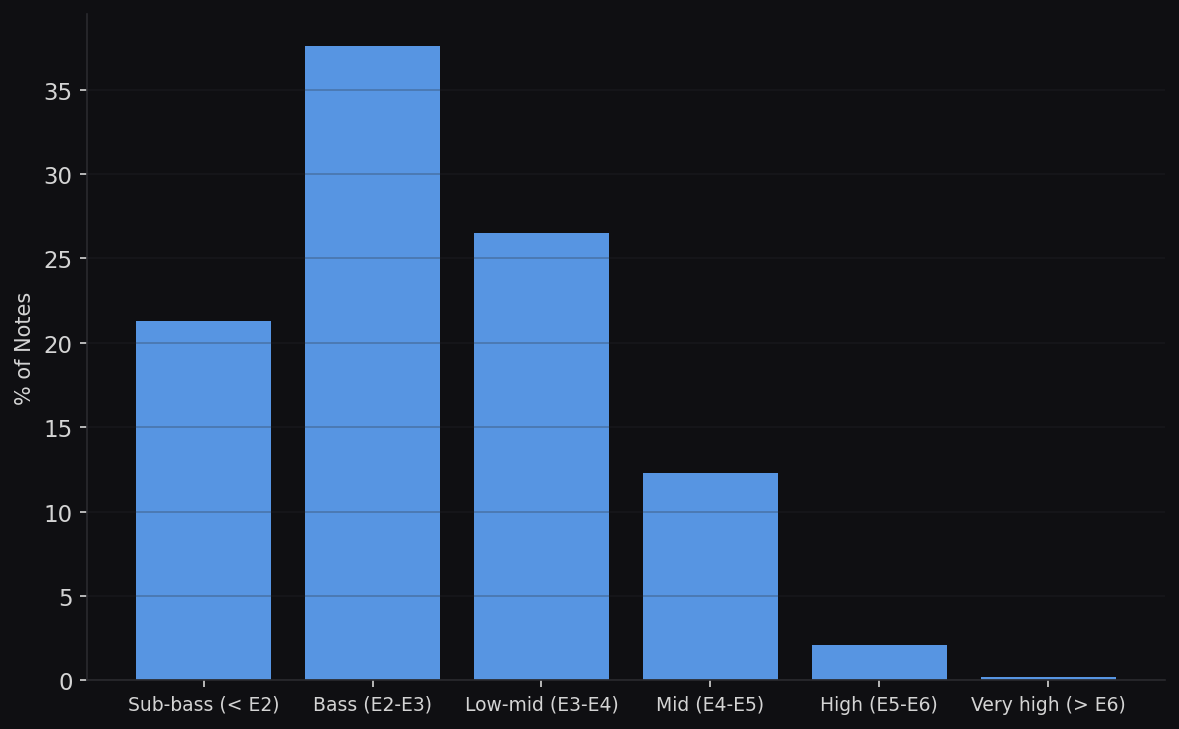
85.4% of your notes are below E4 (middle C area). You are a bass-register musician. Even your guitar parts tend to sit in the lower strings. The high register (above E5) barely registers — you’re not a lead guitar player in the traditional sense. Your “leads” are in the same register as your rhythm parts, just with different voicings.
This bass-heaviness combined with the octave doubling creates your characteristic “wall” — a dense mass of low-to-mid frequencies with octave shimmer above.
6. Rhythm — Fast and Free
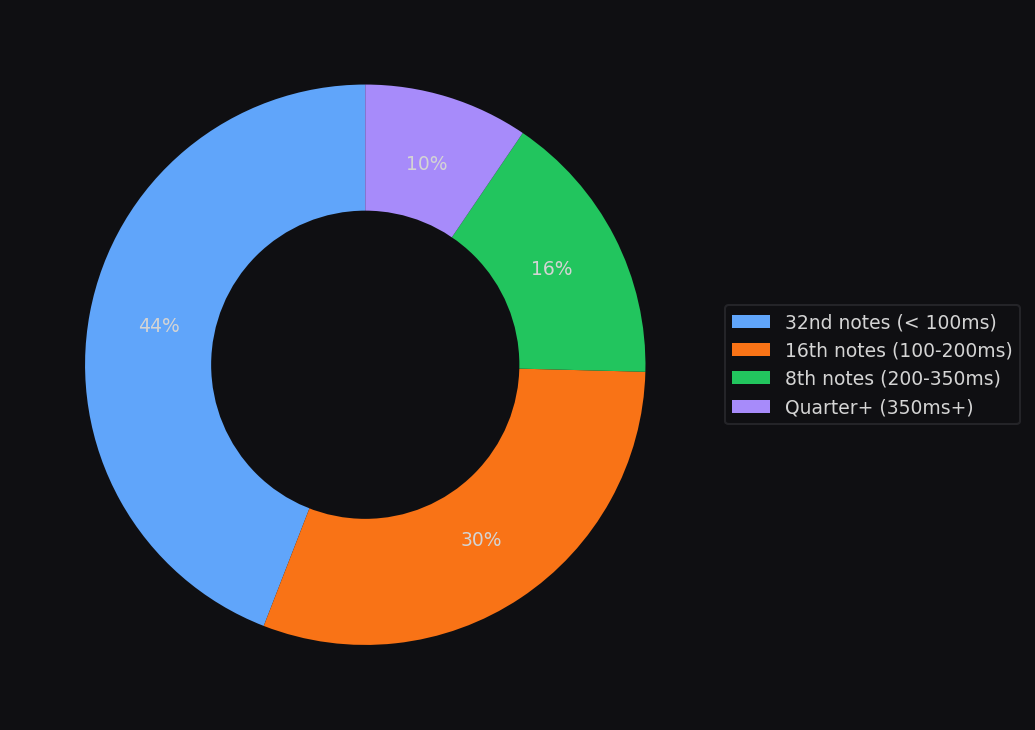
74.6% of your note attacks happen within 200ms of each other. You play fast — constant 16th-note and 32nd-note subdivisions. But your rhythmic regularity score averages -0.05, which means your timing is deliberately loose — you’re not locked to a grid. You speed up and slow down organically.
This combination of fast notes + loose timing = the punk/indie feel. It’s what separates you from a metal player (fast + tight) or a jazz player (loose + varied speed).
7. Your “Chord Shapes” — Named Patterns
Based on the most recurring motifs, here are the hand positions/patterns you return to constantly. Since you have your own names for these, here’s what they are in theory terms:
“The Bounce” (most common)
octave down -> octave up -> octave down
Rapidly alternating between the same note in two octaves. Your #1 move.
”The Drone Bounce”
repeat -> 5th up -> 5th down
Hitting a note, jumping to its 5th, coming back. Creates a bagpipe-like drone effect.
”The Pedal”
octave down -> repeat -> repeat
Drop an octave then hammer on the same note. Anchoring.
”The Shimmer”
octave up -> repeat -> octave down
Leap up, sit there, fall back. The Built to Spill sparkle.
”The Fifth Zigzag”
5th down -> 5th up -> 5th down
Bouncing between root and fifth repeatedly. The root+5th idiom in motion.
8. The Band as Instrument — Why the Fingerprint Never Moves
The most unusual thing in this data isn’t any single chord or technique — it’s that the fingerprint is almost identical across every configuration. Le Rug with two drummers, Le Rug solo, Butter the Children with a full band, solo instrumentals on SoundCloud, the Bangkok record — the harmonic ambiguity rate, the octave doubling, the zigzag, the register, the open-string pitch classes all hold steady. Fifteen years, six projects, dozens of collaborators, and the core numbers barely budge.
That’s not how bands normally work. In a collaborative group, the sound shifts when the lineup changes — new players bring new instincts. Here, the lineup changes and the sound stays the same. The band members were executing a singular vision, not contributing to a shared one.
This puts Ray in a specific lineage of bandleaders:
- Captain Beefheart composed by singing and humming parts to the Magic Band, making them learn complex passages note-for-note. The musicians were skilled but were playing Beefheart’s music, not their own. The band’s sound didn’t change when members were replaced — Beefheart’s ear was the constant.
- Mark E. Smith cycled through ~66 members of The Fall over 40 years. Guitarists, bassists, drummers came and went. The Fall always sounded like The Fall, because Smith controlled the aesthetic absolutely — famously turning down amps mid-set, dictating arrangements, firing anyone who pushed back.
- Ray Weiss wrote all the material across every project, controlled the arrangements, and eventually just did everything himself from Dead In A Hole onward. The BtC EP is telling: he played guitar AND drums, wrote all four songs. When collaborators were present, they were playing his parts.
The data can’t tell you about personality or rehearsal dynamics, but it can show you the outcome: a harmonic signature that doesn’t bend to accommodate other musicians. That’s either total creative control or an extraordinary coincidence across 439 tracks.
The trajectory also fits the pattern. Beefheart retired from music to paint. Smith kept at it until he died but burned through every relationship along the way. Ray sold his instruments and moved to board wargame design — a creative form where the designer has complete, uncompromised control over every system and interaction, and nobody else needs to be in the room.
Summary: The Ray Weiss Formula
If someone wanted to write music that sounds like you, the recipe is:
- Tune to standard, let open strings ring
- Root+5th voicings as the foundation (D, A, G, E shapes)
- Double everything in octaves — play the riff, then play it an octave up simultaneously or in alternation
- Write melodies that zigzag — don’t go on long climbs, oscillate around a note
- Stay in the low-mid register — your melodies live where most people’s rhythm parts live
- Play fast but loose — 16th notes but not metronomic
- Mix sus2 and sus4 for ambiguity when you want color
- Don’t resolve — your songs sit in harmonic suspension rather than clearly landing on major or minor
- Keep it short — say what you need to say and get out
The theoretical underpinning is a kind of intuitive modal ambiguity — by heavily using root+5th voicings (which lack a 3rd) and letting open strings add chromatic color, you avoid ever committing to a key center for too long. This creates a sense of movement and tension that doesn’t need “correct” chord progressions to work. You found your way to something that music theorists would call pandiatonicism — freely using all the notes available in your tuning system without worrying about key — entirely by ear.
9. Where It Comes From, Where It Goes
Running the same analysis pipeline on Ray’s stated influences produced a precise inheritance map:
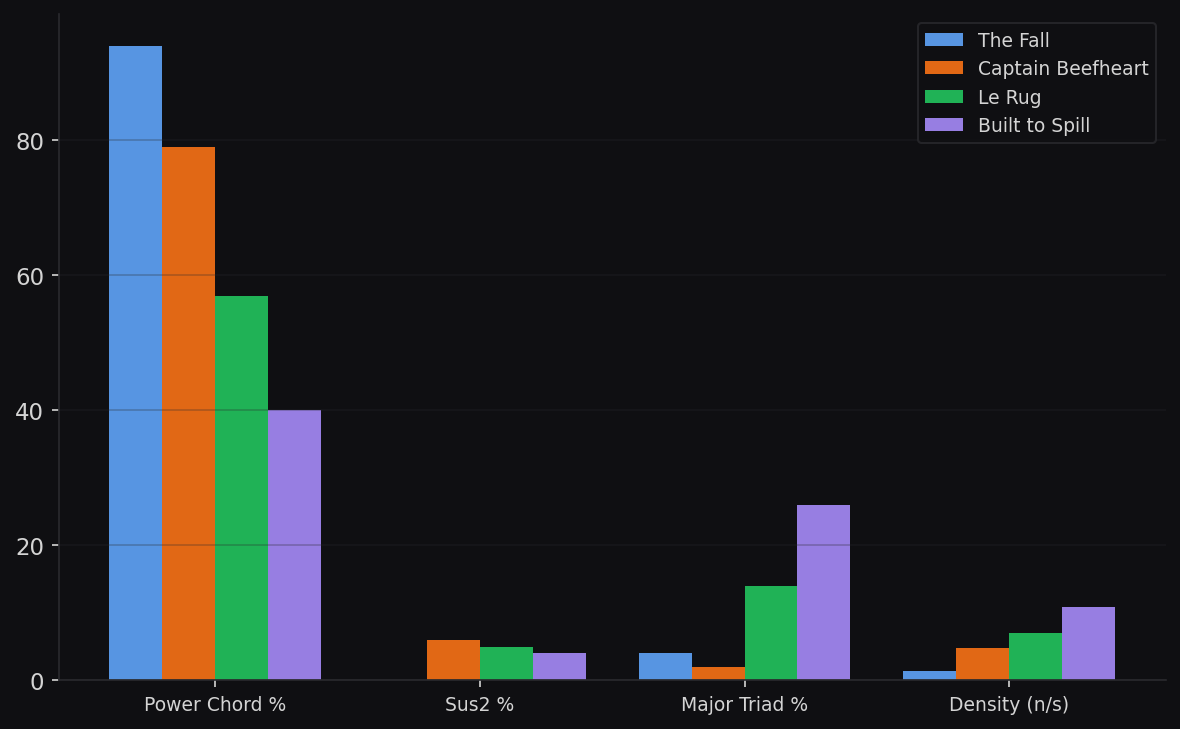
| Trait | Closest To | Evidence |
|---|---|---|
| Harmonic ambiguity rate | Built to Spill | 49% vs 53% — nearest of the three |
| Harmonic richness (major triads) | Between BtS and Fall | BtS 25.5%, Ray 13.8%, Fall 7.1% |
| Sus2/Sus4 balance | Beefheart | 5.8%/5.5% vs Ray’s 5.8%/5.1% — nearest match |
| Density and tempo | Built to Spill | 8.8 n/s and 205 BPM vs Ray’s 7.0 and 196 |
| Bass-heavy register | The Fall | 65.5% vs 56.0% — both bass-heavy |
| Melodic direction | Built to Spill | 46/47% vs 45/45% — identical zigzag |
| Overall fingerprint | Built to Spill | Similarity 0.0382 (closest by a wide margin) |
With full album samples (66 Fall tracks, 57 Beefheart, 44 Built to Spill), Built to Spill emerges as the closest structural match — nearly identical chord balance, register, and melodic movement. The Fall and Beefheart are both ~74% harmonic ambiguity, 20 points higher than Ray — simpler than they sound. See Influence Fingerprint Comparison for the full analysis.
Separately, comparisons with music Ray gravitates toward — but didn’t influence him — revealed unexpected connections. Takahashi/YMO shares 56% harmonic ambiguity (vs Ray’s 53%) and 2/3 key centers. Yugowave shares rhythmic regularity and bass-heavy register despite completely different chord vocabulary and tempo.
The most striking discovery: Dead or Alive is the closest structural match to Le Rug of any artist analyzed — near-identical tempo (199 vs 196 BPM), identical melodic direction (45/45/10), similar bass register (59% vs 56%). A Hi-NRG synth-pop band from Liverpool. See Dead or Alive - The Hidden Match and The Full Comparison Map for the complete 8-group analysis.
10. Validation and Extensions
The core fingerprint has been tested from multiple angles:
- Producer Fingerprint & Other Deep Dives — Three producers (DeNicola, Jesse Harris, Scott Andrews) modulate but don’t change the fingerprint. DeNicola brought out the most harmonic richness (24% major triads); self-produced ABH is paradoxically the most mature. Vocals vs instrumentals: nearly identical fingerprints.
- Era Fingerprints — Harmonic ambiguity rate is inversely correlated with density (sparse eras are more ambiguity-heavy, dense eras have more harmonic variety). Bass register and melodic direction are constant across every era.
- Deep Dive - Song Evolution & Comparisons — The Grim Reefer was completely rewritten between 2015 and 2020, migrating from outlier keys (D#/F#/A#) to home keys (C/E/A). C.R.E.E.P. and SRF share 5 tracks but all are different recordings.
- Drum Analysis — Drum structure evolved orthogonally: double-drum eras (loose, groovy, snare-heavy) vs solo eras (tight, kick-heavy, complex). Note: pitched-instrument analysis in this document doesn’t capture drum patterns.
- The Full Comparison Map — 8 artist groups analyzed. Each genre Ray gravitates toward shares a different subset of his structural traits. The complete Le Rug fingerprint exists in no other artist, but fragments of it exist in everything from Beefheart to Italo disco to Japanese electronic pop.
The complete picture: Ray’s musical DNA is singular and stable across collaborators, producers, eras, and instruments. When elements varied (drum feel, harmonic density, key centers), the core identity remained constant. And the music he gravitates toward as a listener maps precisely to the structural properties of his own output.