Era Fingerprints
Comparing the musical DNA across each phase of the catalog. What changed, what didn’t, and what the numbers reveal that the ear might miss.
The Comparison
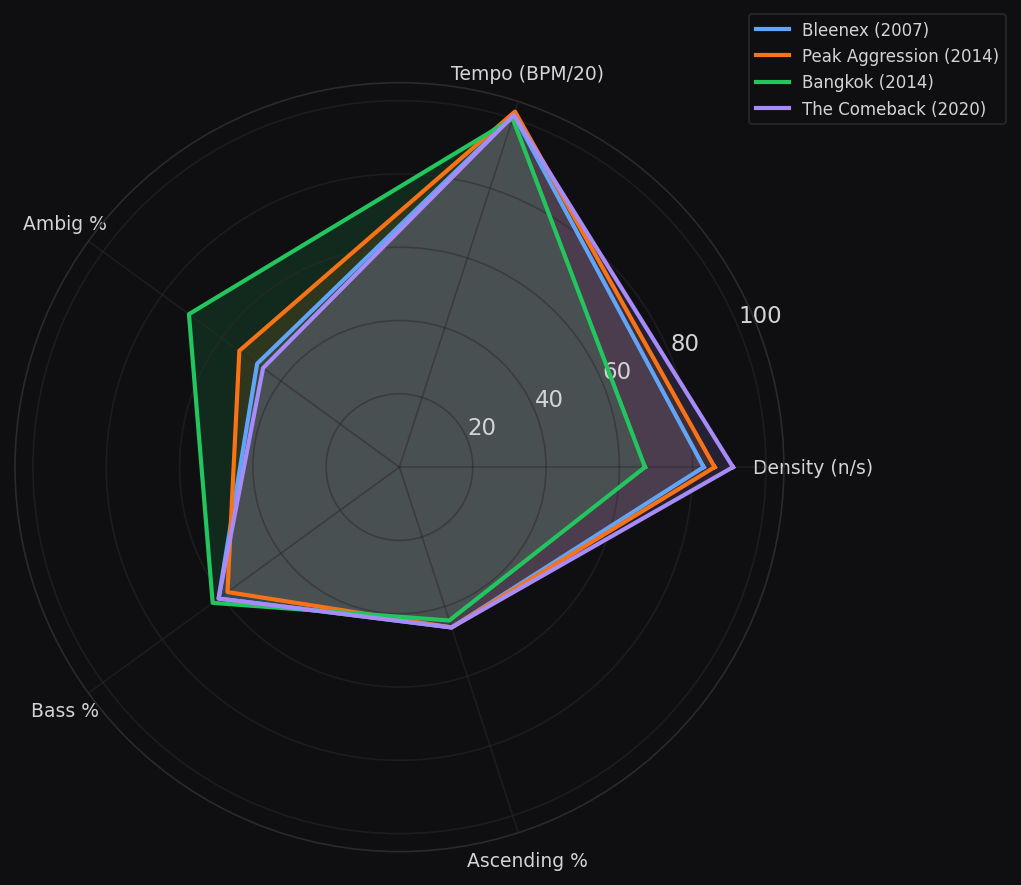
Density and tempo scaled for visual comparison. Actual values in table below.
| Era | Tracks | n/s | BPM | Ambig % | Bass % | Asc % | Key Centers |
|---|---|---|---|---|---|---|---|
| Bleenex (2007) | 13 | 8.3 | 202 | 48% | 61% | 46% | A, G, F |
| Twin Albums (~2008) | 25 | 7.1 | 195 | 56% | 61% | 45% | E, G, A |
| Experimentation (~2009-10) | 48 | 5.9 | 199 | 65% | 53% | 44% | E, B, A |
| The Outlier (Sticky Buns) | 3 | 3.5 | 179 | 74% | 81% | 38% | F#, C#, D |
| Peak Aggression (2014) | 31 | 8.6 | 204 | 54% | 58% | 46% | E, D, G |
| Bangkok (2014) | 11 | 6.7 | 200 | 71% | 63% | 44% | G, E, F# |
| Solo Explorations | 37 | 6.2 | 196 | 56% | 56% | 43% | D, G, C |
| The Comeback (2020) | 13 | 9.1 | 201 | 46% | 61% | 46% | C, A, E |
What the Numbers Reveal
1. Harmonic Ambiguity and Density Are Inversely Related
“Harmonic ambiguity” here refers to chord events where the MIDI transcriber could not detect a clear third — closely correlated with the power chord idiom but not literally a count of intentional power chord voicings. See Chord Vocabulary for details.
This is the opposite of the assumption. The sparsest eras have the highest harmonic ambiguity rates:
- Sticky Buns (3.5 n/s) = 74% harmonic ambiguity
- Bangkok/Swelling (6.7 n/s) = 71% harmonic ambiguity
- Bleenex (8.3 n/s) = 48% harmonic ambiguity
- ABH/Comeback (9.1 n/s) = 46% harmonic ambiguity
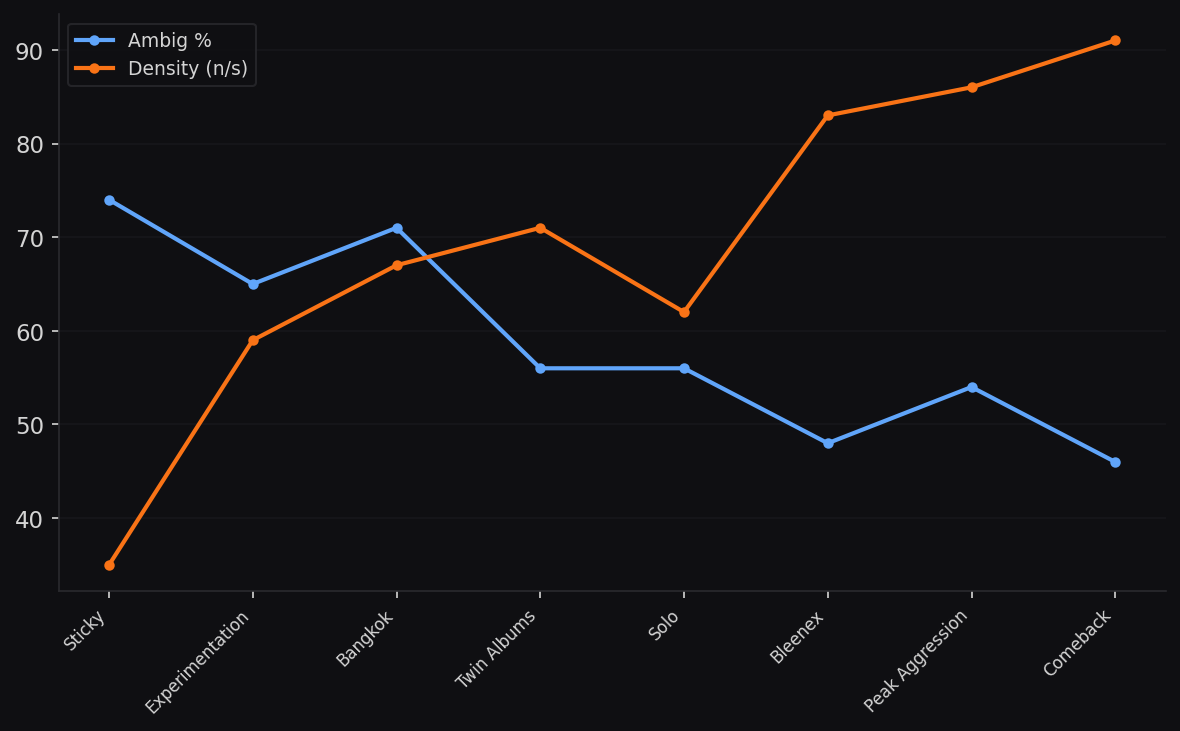
Density scaled x10 for visual comparison.
When playing fewer notes, nearly every chord event reads as ambiguous. When playing more notes, those extra notes start registering as triads, 7ths, sus chords, add9s — the detectable harmonic vocabulary expands to fill the space. Density and harmonic complexity move together, not against each other. The dense, “aggressive” tracks are actually the most harmonically rich.
2. The Comeback Is the Most Harmonically Diverse Era
ABH (2020) has the lowest harmonic ambiguity rate of any era: 46%. Less than half. This is the “mature synthesis” in hard numbers — by 2020, the chord palette had opened up to include more triads, suspended chords, and extensions than at any other point.
Combined with the highest density (9.1 n/s), this means ABH packs more harmonic information into more notes per second than anything else in the catalog. It’s simultaneously the busiest and the most varied.
3. Bass Percentage Is Remarkably Stable
Across every era, bass-register notes (sub-bass + bass, below E3) hover between 53% and 63%. The one outlier is Sticky Buns at 81% — almost entirely bass register. This stability means the bass-heavy character isn’t a choice that changed over time; it’s a fixed property of how Ray plays the instrument. The guitar sits in the bass register regardless of era, project, or density.
4. Melodic Direction Never Changes
Ascending movement is between 38% and 46% across all eras. Descending is the mirror. The zigzag pattern is completely constant — it doesn’t matter if you’re playing 3.5 or 9.1 notes per second, the melodic oscillation ratio stays the same. This is probably the most deeply ingrained aspect of the fingerprint — it’s not a stylistic choice, it’s a physical habit of how Ray’s hands move on the fretboard.
5. Key Centers Tell a Story
2007:      A, G, F     (A-centered, unique to Bleenex)
2008:      E, G, A     (shift to E)
2009-10:   E, B, A     (E dominates)
Sticky:    F#, C#, D   (outlier — deliberately off the open strings)
2014:      E, D, G     (back to open-string territory)
Bangkok:   G, E, F#    (F# intrusion — Swelling anomaly)
Solo:      D, G, C     (brighter shift)
2020:      C, A, E     (brightest — return to open strings)
The trajectory: started A-centered, spent years in E territory, and ended up C/A-centered. The key centers got progressively brighter over time. The only departures are Sticky Buns (F#/C# — deliberately dark) and Bangkok/Swelling (F# appearing alongside the standard centers).
The Most and Least Distinctive Tracks
Most Distinctive (furthest from the catalog average)
| Track | Album | n/s | BPM | Ambig% | Why it’s unusual |
|---|---|---|---|---|---|
| Indefinite Diagnosis | Flabby Wings | 17.2 | 217 | 1% | Near-zero ambiguity, 84% mid/high register — the anti-fingerprint |
| Gloss | Bleenex | 17.2 | 214 | 7% | Dense from note one, register-shifted upward |
| Miserable Nostalgia | Flabby Wings | 15.2 | 215 | 0% | Zero ambiguity — pure triads and extensions |
| Eat Shit City | ABH | 18.0 | 198 | 16% | Densest track in the catalog by raw n/s |
| Movement 1 | Flabby Wings | 14.7 | 214 | 18% | Extended composition, upper register |
| Aquatic Amphetamines | Defenestrator | 1.0 | 118 | 100% | The opposite extreme: one note per second, fully ambiguous |
The most distinctive tracks cluster at two extremes: ultra-dense instrumentals with almost no harmonic ambiguity (Flabby Wings), and ultra-sparse pieces that are entirely ambiguous (Defenestrator, Bad Cop). The “Le Rug sound” lives in between.
Most Average (closest to the catalog norm)
| Track | Album | n/s | BPM | Ambig% | Score |
|---|---|---|---|---|---|
| Birth Control | Swelling | 6.6 | 197 | 57% | 0.20 |
| FDR | America | 6.5 | 202 | 62% | 0.21 |
| N.C.O. | Ersatz EP | 6.8 | 205 | 67% | 0.27 |
| Birds | C.R.E.E.P. | 7.1 | 198 | 53% | 0.27 |
Birth Control from Swelling (the Bangkok record) is statistically the most “average” Le Rug track in the entire catalog. 6.6 n/s, 197 BPM, 57% harmonic ambiguity — dead center on every metric. This is notable because Swelling was recorded alone, on the other side of the world, during a low period. The most isolated recording conditions produced the most characteristic sound. Another data point for the singular-vision thesis.