Deep Dive — Song Evolution & Comparisons
Tracking how songs change across versions and albums. First prototype of the CatalogDNA song evolution feature.
1. The Grim Reefer: 2015 vs 2020
The Grim Reefer appears on Game Over (2015, Fleeting Youth compilation) and Anyone But Hindenburg (2020). Five years apart. The question: how did the song evolve?
Answer: it didn’t evolve. It was rewritten from the ground up.
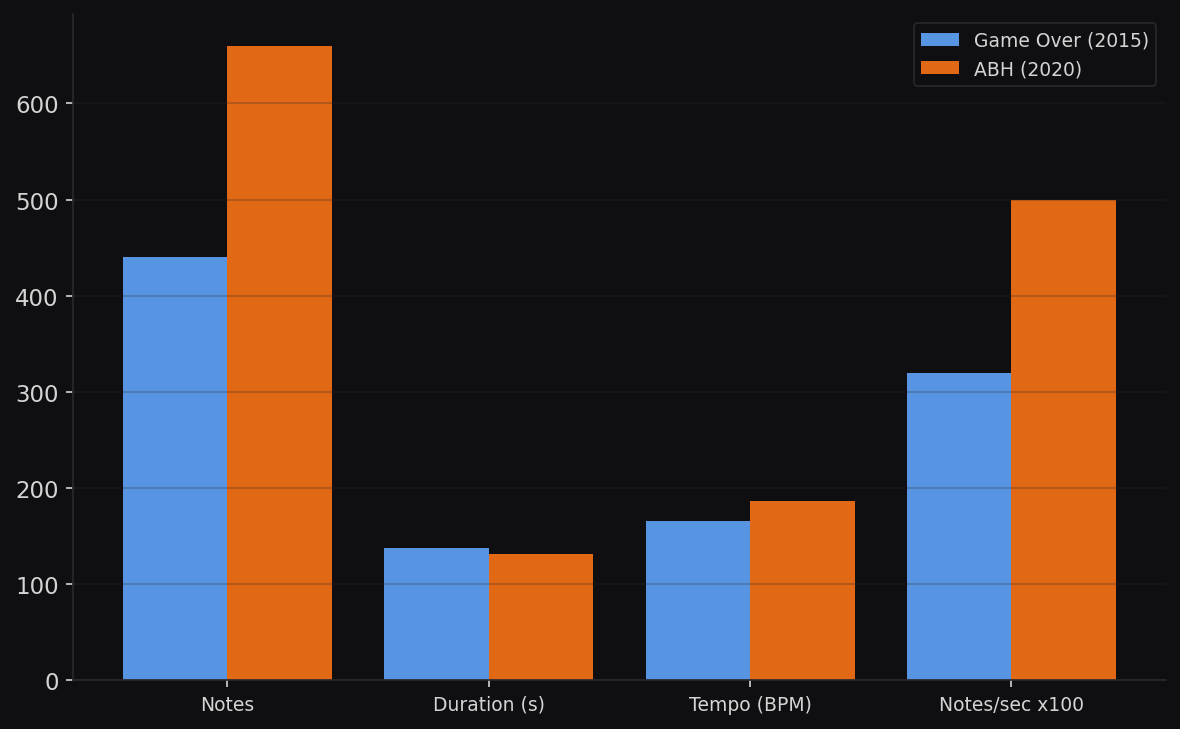
| Metric | Game Over (2015) | ABH (2020) | Change |
|---|---|---|---|
| Notes | 440 | 660 | +50% |
| Duration | 137.8s | 131.2s | Shorter but denser |
| Tempo | 166 BPM | 187 BPM | +21 BPM |
| Density | 3.2 n/s | 5.0 n/s | +56% |
The Key Center Completely Changed
| Pitch | 2015 | 2020 | What happened |
|---|---|---|---|
| D# | 25.9% | 0.0% | Disappeared entirely |
| F# | 13.0% | 0.3% | Gone |
| A# | 12.3% | 0.0% | Gone |
| C | 5.9% | 22.6% | New dominant |
| E | 2.5% | 21.2% | New dominant |
| A | 0.2% | 18.3% | New dominant |
| F | 1.6% | 18.5% | New dominant |
The 2015 version lives in D#/F#/A# — dark, flat-key territory far from the open strings. The 2020 version migrated to C/E/A/F — the bright, open-string-resonant center that defines the catalog. The song literally moved from an outlier key center to the home key center over 5 years.
Chord Vocabulary Shift
2015: D# power chord dominates, with G# and F# power chords. A G# diminished chord appears (almost never used anywhere else in the catalog).
2020: A power chord dominates, with G and F power chords. Sus2 and sus4 voicings appear (C sus2, D sus4, A sus4) — the signature ambiguity that barely existed in the 2015 version.
Register Shift
The 2020 version is dramatically bass-heavier: bass register went from 17% to 38%, while low-mid dropped from 29% to 12% and mid from 20% to 11%. The song sank lower on the neck.
What This Means
The Grim Reefer wasn’t refined — it was re-approached. By 2020, Ray’s instincts had settled further into the open-string DNA (C/E/A centers, sus2/sus4 ambiguity, bass-heavy register). The 2015 version was an outlier in the catalog; the 2020 version sounds like the catalog. The song converged toward the fingerprint rather than away from it.
This is the opposite of what you’d expect. Most musicians’ later versions of songs become more experimental. Here, the later version became more characteristic — more “Ray.”
2. 1779: SoundCloud vs Game Over
1779 appears as a SoundCloud single and on the Game Over compilation.
Verdict: Same recording. 16-note difference across 2,400+ notes (0.7%). Identical duration (226.8s). Tempo within 1.6 BPM. No significant pitch class or register shifts. The SoundCloud rip and the Bandcamp album version are the same master.
This serves as a control — it shows what “same recording, different source” looks like in the data, so we can distinguish it from “actually different takes.”
3. C.R.E.E.P. vs Sex Reduction Flower — The Shared Tracks
C.R.E.E.P. and Sex Reduction Flower share 5 tracks: Tripper, 2C-E, Sweet Kicks, Buffalo, Hugo. These two albums come from the same creative period (~2008). The question: are these the same recordings repackaged, or different takes?
Answer: ALL FIVE are different recordings.
| Track | SRF | C.R.E.E.P. | Note Diff | Duration Diff | Density Shift |
|---|---|---|---|---|---|
| Tripper | 1,087 notes, 8.0 n/s | 1,008 notes, 7.2 n/s | 79 | 2.4s | -10% |
| 2C-E | 952 notes, 7.7 n/s | 720 notes, 4.7 n/s | 232 | 28.8s | -39% |
| Sweet Kicks | 617 notes, 5.4 n/s | 896 notes, 6.8 n/s | 279 | 18.1s | +26% |
| Buffalo | 1,095 notes, 7.6 n/s | 1,170 notes, 8.4 n/s | 75 | 4.8s | +11% |
| Hugo | 1,165 notes, 7.9 n/s | 1,789 notes, 11.7 n/s | 624 | 6.9s | +48% |
The Hugo Case
Hugo is the most dramatic. The C.R.E.E.P. version is 48% denser than the SRF version — 11.7 n/s vs 7.9 n/s. That’s the difference between a mid-catalog density and one of the densest tracks in the entire output. The CREEP version also introduces minor 7th and major 7th chords that don’t appear in the SRF version at all — it’s harmonically more complex, not just denser.
The 2C-E Case
Going the other direction: the SRF version of 2C-E is 30 seconds shorter but significantly denser (7.7 vs 4.7 n/s). The CREEP version is longer and sparser — a stretched-out, more spacious arrangement of the same song.
What This Means
SRF and C.R.E.E.P. aren’t a repackaging — they’re two different recordings of the same material, probably from different sessions or different takes chosen for each album. Some songs got denser in the CREEP versions (Hugo, Buffalo, Sweet Kicks), while others got sparser (Tripper, 2C-E). There’s no consistent direction — it’s not that one album is “the rough cut” and the other is “the polished version.” They’re parallel interpretations.
This is consistent with the dual-album era (~2008) being an experimental period — trying the same songs in different configurations to see which version worked.
4. The Outliers — Game Over’s Hidden Tracks
The Game Over unreleased tracks include several that are dramatically different from the catalog norm.
Palm Beach — The Bass Piece
| Metric | Palm Beach | Catalog Average |
|---|---|---|
| Density | 1.5 n/s | 6.9 n/s |
| Tempo | 120 BPM | 196 BPM |
| Sub-bass | 60.5% | 19.6% |
| Velocity | avg 51 | ~70-80 |
263 notes in nearly 3 minutes. 60% sub-bass register. Average velocity of 51 (quiet). Tempo at 120 BPM — the slowest in the catalog. The rhythm distribution is nearly flat across all buckets (no dominant subdivision) — there’s no consistent rhythmic pulse.
This isn’t a song — it’s closer to a bass sketch or ambient drone piece. The D/F/C pitch classes suggest Dm territory. It’s the closest thing in the Le Rug catalog to Defenestrator’s hardware noise aesthetic, except played on bass guitar instead of synths.
Bad Cop — The Sparse Power Chord Study
183 notes. 100% harmonic ambiguity — every chord event reads as root+5th with no detectable third.1 B/D# center (unusual — the same dark key territory as the 2015 Grim Reefer). The register is uniquely balanced: almost equal across sub-bass, bass, low-mid, and mid. Most Le Rug tracks are bottom-heavy; this one is spread evenly.
A deliberate, minimal piece — every note is placed rather than strummed. The antithesis of the 16th-note-barrage that defines most of the catalog.
Gabriel — The G Drone
G dominates at 40% — the most single-note-dominant track in the catalog. 71.4% low-mid register (most tracks are bass-heavy, not low-mid-heavy). C power chord is the top chord shape.
This is a drone piece built on G, with the C power chord providing the harmonic movement. At 4.1 n/s it’s not sparse — just monochromatic. Where most Le Rug tracks use 6-8 pitch classes roughly equally, Gabriel uses one note for almost half its content.
What the Outliers Tell Us
These tracks weren’t released on any named album. They ended up on Game Over as “unreleased loosies.” They represent the material Ray chose not to put on a record — and the reasons are visible in the data. They don’t fit the Le Rug fingerprint: too slow (Palm Beach), too sparse (Bad Cop), too monochromatic (Gabriel), wrong register (Palm Beach’s sub-bass dominance).
They’re interesting precisely because they’re the negative space — the music that defines the boundaries of the style by sitting outside them. A Le Rug track is fast, dense, bass-heavy, chromatically rich, power-chord-driven. These tracks are what happens when one or more of those parameters is removed.
Footnotes
-
“Harmonic ambiguity” here refers to chord events where the MIDI transcriber could not detect a clear third — closely correlated with the power chord idiom but not literally a count of intentional power chord voicings. See Chord Vocabulary for details. ↩