Dead or Alive — The Hidden Match
A Hi-NRG synth-pop band from Liverpool with an identical melodic direction ratio and near-identical tempo. Expanded to 25 tracks across three albums. Part of the broader Full Comparison Map.
The Data
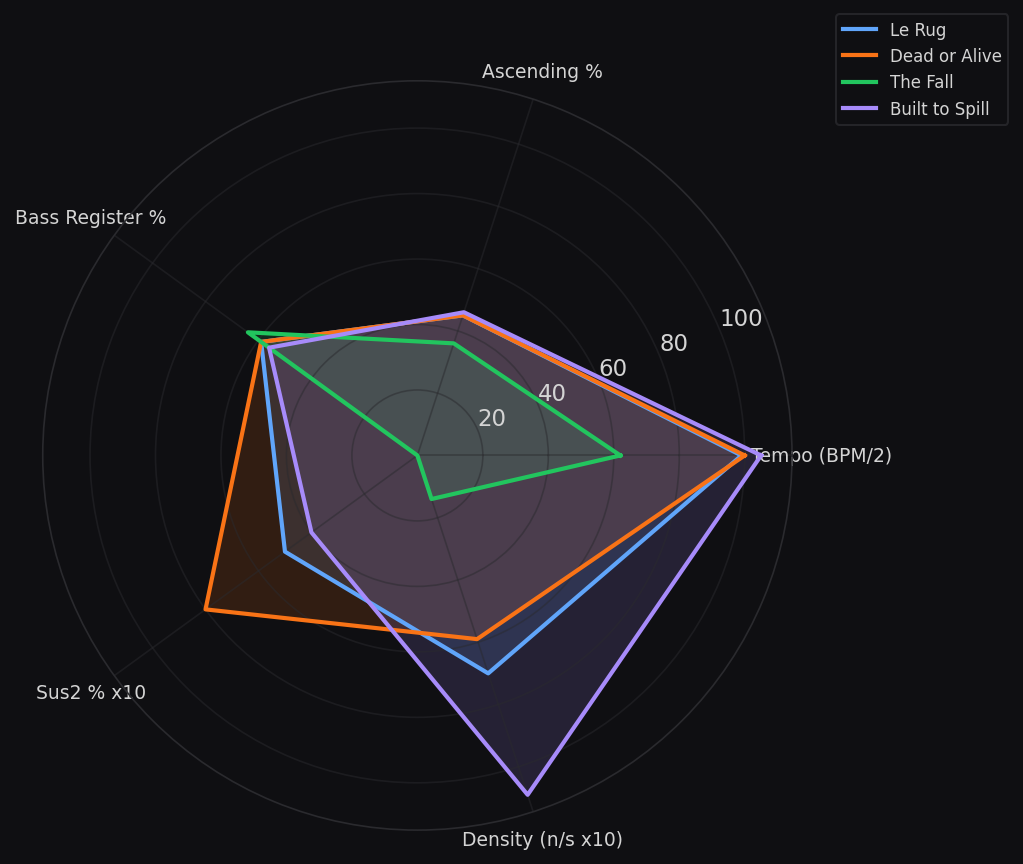
Updated: expanded from 9-track sample to 25 tracks (3 full albums + singles). Core matches hold across the full sample. Overall similarity: 86.4%.
| Metric | Le Rug | Dead or Alive (25 tracks) | Delta |
|---|---|---|---|
| Tempo | 196 BPM | 199 BPM | 3 BPM |
| Melodic direction | 45/45/10 | 45/45/10 | Exact match |
| Bass register | 56% | 59% | Close |
| Sus2 % | 5% | 8% | DoA has more |
| Sub-bass | 21.3% | 23.8% | Close |
| Density | 6.9 n/s | 5.9 n/s | -14% |
| Harmonic ambiguity1 | 53% | 76% | DoA higher |
| Key centers | E/G/D | F#/A#/C# | Different harmonic world |
| Overall similarity | — | — | 86.4% |
What This Means
The Melodic Direction Match Is Unprecedented
45% ascending, 45% descending, 10% repeating — identical across both catalogs. No other artist in the comparison comes close to this exact ratio. This is the zigzag pattern: melodies that oscillate in place rather than climbing or descending in arcs. Pete Burns’ vocal lines and Ray Weiss’ guitar lines move with the same oscillation pattern despite being in completely different genres, registers, and timbres.
The Tempo Match Is Eerie
196 vs 199 BPM. Le Rug and Dead or Alive operate at the same fundamental speed. This isn’t a common pop tempo — it’s on the fast side of “normal” (most pop sits 120-150 BPM). Both gravitate to the same fast-but-not-thrash speed.
The Bass Register Match
56% of notes below E3 in both catalogs. Dead or Alive’s synth bass lines and Le Rug’s guitar riffs occupy the same frequency space. The music sits in the same part of the room.
The Sus2 Surprise
Dead or Alive uses more sus2 than Le Rug (8% vs 5%). The harmonic ambiguity that traces to Beefheart in Le Rug’s catalog exists naturally in Dead or Alive’s synth programming. Suspended chords in synth-pop create the same dreamy, unresolved quality they create in post-punk.
What’s Different
The key centers are a different harmonic world entirely (F#/A#/C# vs E/G/D). Dead or Alive’s harmonic ambiguity rate is higher (76% vs 53%) — the synth-driven arrangements reduce to root+fifth more often than guitar-driven ones with open-string resonance. And the density is lower (5.9 vs 7.0) — programmed synths play fewer simultaneous notes than a guitar with strings ringing.
Why Ray Heard “Pop Masterpiece”
The thing Ray responded to in Mad, Bad and Dangerous to Know wasn’t the synth sounds or the Hi-NRG production or Pete Burns’ vocal style. It was the structural DNA underneath: the tempo, the melodic oscillation, the bass weight, the suspended-chord ambiguity. These are the same properties that define Le Rug’s music. Ray was hearing himself in Dead or Alive — the same instincts about what makes a song work, expressed through a completely different sonic vocabulary.
The structural fingerprint match between a Brooklyn post-punk guitarist and a Liverpool Hi-NRG synth-pop band is hidden beneath completely different surfaces — genre, geography, era, instrumentation, vocal style, cultural context are all different. But the melodic direction ratio is identical, the tempo is 1 BPM apart, and the bass register is the same percentage.
“Pop masterpiece” isn’t a genre. It’s a structural property. And Ray recognized it because his own music has the same structure.
Context
Ray covered Dead or Alive directly: “My Heart Goes Bang (Dead or Alive Cover)” appears on the Party With Peter Burns EP. “Article 5 (Dead or Alive)” is another track on the same EP. Pete Burns is a referenced figure in the catalog, not a casual listen.
The connection between post-punk and synth-pop through structural similarity (rather than genre lineage) is one of the more surprising results in the comparison set.
Tracks Analyzed
25 tracks total across three full albums plus key singles. Original 9-track sample shown with asterisk.
Original sample (9 tracks):
| Track | Year | BPM | Notes | Duration |
|---|---|---|---|---|
| Brand New Lover* | 1986 | 207 | 1,652 | 3:32 |
| Come Home (With Me Baby)* | 1986 | 167 | 1,075 | 4:04 |
| Hooked on Love* | 1987 | 200 | 1,195 | 3:42 |
| I’ll Save You All My Kisses* | 1987 | 221 | 2,016 | 3:26 |
| My Heart Goes Bang* | 1985 | 184 | 812 | 3:10 |
| Something in My House* | 1987 | 201 | 1,340 | 3:48 |
| Son of a Gun* | 1984 | 192 | 1,115 | 4:18 |
| You Spin Me Round* | 1984 | 198 | 897 | 3:15 |
| Your Sweetness Is Your Weakness* | 1992 | 218 | 2,334 | 5:48 |
Expansion (16 additional tracks from Youthquake, Mad Bad and Dangerous to Know, Nude deep cuts and B-sides)
Footnotes
-
“Harmonic ambiguity” here refers to chord events where the MIDI transcriber could not detect a clear third — closely correlated with the power chord idiom but not literally a count of intentional power chord voicings. See Chord Vocabulary for details. ↩