Prefab Sprout — Steve McQueen as the Tightest Match
Prefab Sprout — Steve McQueen (1985) is the single tightest full-album chord-vocabulary match in Ray Weiss’s reference DB, at distance 1.69 on the 3-dimensional metric. It reached that position through a data-quality cleanup that sharpened the distance by 3.75 units: the pre-cleanup sample contained two 2007 remastered re-recordings contaminating a 5-track subset, and the tool was detecting the contamination through the distance number itself. After replacement with the clean 11-track 1985 UK original, the distance collapsed from 5.44 to 1.69 and Steve McQueen became the reference DB’s #1 structural neighbor. The case study is three findings in one: the tightest match the project has produced, a methodology validation from the cleanup, and the completion of the chord-vocabulary envelope that Modest Mouse opens.
The Data
Against the 148-entry reference DB as of 2026-04-15, the two Prefab Sprout albums in the DB sit at:
| Album | Rank | 3-dim Distance | Sus % | Major % | Minor % |
|---|---|---|---|---|---|
| Steve McQueen (1985) | #1 | 1.69 | 12.1 | 14.01 | 7.94 |
| Langley Park to Memphis (1988) | ~#7 | ~3.71 | 13.36 | 7.08 | 6.62 |
| Ray Weiss (reference catalog) | — | 0 | 10.9 | 13.8 | 6.7 |
Steve McQueen at 1.69 is the single tightest chord-vocabulary match in the reference DB. The #2 position (Kate Bush — Hounds of Love at 2.26) is a full 0.57 distance units further. The #3 position (Frank Black S/T at 2.47) is further still. No other entry in the 148-entry DB comes within half a unit of Steve McQueen’s match to Ray.
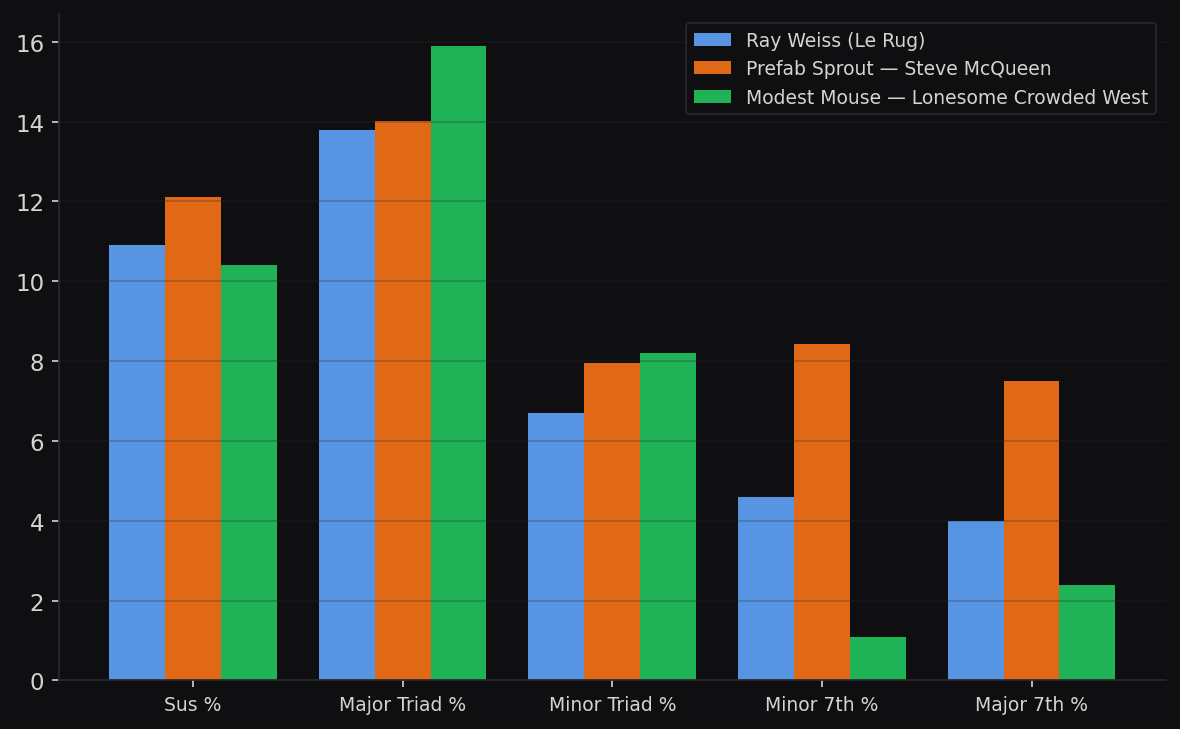
Across the three catalogs above, the pattern is visible: Ray and Modest Mouse cluster low on the extended chord axes (min7, maj7); Prefab Sprout sits much higher on both. On sus, major triad, and minor triad, all three catalogs stack in the same neighborhood. The extended chord divergence is where the spectrum opens up.
The major triad atomic match
| Catalog | Major Triad % | Delta vs Ray |
|---|---|---|
| Ray Weiss | 13.8% | — |
| Prefab Sprout — Steve McQueen | 14.01% | 0.21 pp |
| Modest Mouse — Lonesome Crowded West | 15.9% | 2.1 pp |
| Kate Bush — Hounds of Love | 13.6% | 0.2 pp |
| Bowie — Low | 10.7% | 3.1 pp |
The major triad match at 0.21 percentage points is the second atomic-level match documented in this vault (after Modest Mouse’s sus chord match at 0.44-0.50 pp). Kate Bush — Hounds of Love is also within 0.2 pp on the same axis, which is part of why that album sits at #2 in the ranking.
The Cleanup Story — Methodology Validation
Before the 2026-04-14 interactive cleanup session, Prefab Sprout — Steve McQueen was represented in the reference DB by a 5-track sample, and its distance to Ray’s catalog was 5.44 — close enough to be a neighbor, not close enough to be the headline.
Investigation during that session revealed two of the five tracks were 2007 Legacy Edition remasters by Paddy McAloon (the Prefab Sprout singer/songwriter and principal composer). The tracks “Bonny 2007 Remastered” and “Appetite 2007 Remastered” were not the 1985 original release performances — they were late-career re-recordings with different voicings, different arrangements, and substantially different harmonic implementations.
The cleanup replaced both contaminated tracks and expanded the sample from 5 to a full 11-track representation of the 1985 UK original release. After re-analysis:
| Measure | Pre-cleanup (5 tracks, 2 contaminated) | Post-cleanup (11 clean tracks) |
|---|---|---|
| Track count | 5 | 11 |
| 3-dim distance to Ray | 5.44 | 1.69 |
| Ranking position | ~#2 | #1 |
The distance dropped by 3.75 units from removing the contamination. That’s a larger shift than most cross-artist distance variations in the DB — the pre-cleanup Prefab Sprout was closer to being in the mid-tier of neighbors than to being the #1 match. The cleanup revealed the true structural similarity by removing the confounding variable.
What this validates
The cleanup story is methodology validation in a way the other case studies aren’t. It demonstrates that the fingerprint is sensitive enough to distinguish not just “different artist” and “different album” but “different voicings of the same song by the same artist 22 years apart.” The 1985 Paddy McAloon and the 2007 Paddy McAloon produce different chord-vocabulary signatures on the same compositions, and the tool was picking up the difference through the distance metric.
If the fingerprint were noise-heavy or insensitive, the 5.44 pre-cleanup number would have stayed in roughly the same neighborhood after adding 6 clean tracks and removing 2 contaminated ones — the averaging would wash out the difference. Instead, the distance collapsed by more than two-thirds. The tool was detecting the contamination through the distance number, not through anything else.
That’s the methodology validation: this is a chord-vocabulary metric sharp enough to pick up re-recording artifacts within a single artist’s catalog. When it says Steve McQueen sits at 1.69, it means the 1985 Steve McQueen — not the 2007 remaster, not the general Paddy McAloon feel, not a blended average of both.
The Chord Vocabulary Spectrum
The Prefab Sprout finding completes a framing that the Modest Mouse case study opens. Ray sits inside a chord-vocabulary spectrum where Modest Mouse defines one pole and Prefab Sprout defines the other:
| Chord Type | Modest Mouse (LCW) | Ray | Prefab Sprout (SMc) |
|---|---|---|---|
| Sus combined | 10.4% | 10.9% | 12.1% |
| Major triad | 15.9% | 13.8% | 14.01% |
| Minor triad | 8.2% | 6.7% | 7.94% |
| Minor 7th | 1.1% | 4.6% | 8.43% |
| Major 7th | 2.4% | 4.0% | 7.51% |
On the triad and sus axes, all three catalogs cluster tightly. On the extended chord axes (min7 and maj7), the pattern is a clean progression: Modest Mouse low, Ray in the middle, Prefab Sprout high.
Ray’s minor 7th density (4.6%) is between Modest Mouse’s 1.1% and Prefab Sprout’s 8.43%, and closer to the midpoint than to either end. Same on major 7ths: Ray’s 4.0% sits between 2.4% and 7.51%. On the jazz-chord axis, Ray’s fingerprint is a genuine blend of the two reference points.
This maps directly onto the pedagogical lineage story from the Modest Mouse case study. Ray’s foundation chord vocabulary (sus density, major / minor triad balance, modal character) came from listening-based absorption during his pre-teen and teen Modest Mouse phase. The extended chord layer (min7, maj7, jazz voicings) came from a high school classmate teaching Wes Montgomery and from formal guitar lessons with Jesse Harris, later a Grammy-winning producer and songwriter on Norah Jones’s Come Away With Me.
Prefab Sprout is what the extension layer actually sounds like at scale. Paddy McAloon is a canonical jazz-chord-informed songwriter — the sophisti-pop movement Prefab Sprout anchors is built around exactly the min7 / maj7 vocabulary that Jesse Harris teaches and that Wes Montgomery embodies. Ray didn’t learn the extensions from Prefab Sprout specifically. But what Ray learned about jazz chords, Prefab Sprout already had, and that explains why the fingerprint sits so close to theirs even though the listening influence was elsewhere.
The spectrum is structural, not biographical. Modest Mouse gave Ray the foundation. Harris / Montgomery gave Ray the extensions. Prefab Sprout is where those two layers combine in another catalog, and that convergence is why Steve McQueen ends up at #1.
1985 — A Harmonically Distinctive Year
Both of the top-two chord-vocabulary matches to Ray’s catalog are albums from 1985: Prefab Sprout — Steve McQueen and Kate Bush — Hounds of Love. The #3 and #4 entries are elsewhere in the timeline (Frank Black from the 2000s, Modest Mouse from the late 90s), but the absolute tightest neighborhood sits on two 1985 records.
This is worth flagging because 1985 is also a notable year for harmonic distinctiveness against radio-era mainstream. Both albums were critical and commercial successes that sat one step sideways from the production values of their era. Thomas Dolby produced Steve McQueen with sparse, sophisticated arrangements that let Paddy McAloon’s chord voicings breathe. Kate Bush produced Hounds of Love herself on the Fairlight CMI, with chord choices that lived outside the mid-80s pop harmonic vocabulary. Neither album sounds like the radio of its year. Both sit at the structural top of Ray’s reference DB.
The pattern suggests the similarity is not “two mid-80s artists happen to share DNA with Ray” but “two harmonically sophisticated outliers from the same year happen to share DNA with Ray.” The cross-era consistency of the match — Modest Mouse from the late 90s, Prefab Sprout and Kate Bush from 1985, Bowie’s Low from 1977 — argues for the match being about compositional instincts, not era-specific stylistic traits.
Context — The “Neglected to Mention” Pattern
Prefab Sprout was not in Ray’s pre-existing stated list of formative influences. It surfaced in the 2026-04-14 home-PC interactive session when Ray predicted, without any supporting data, that Love — Forever Changes would rank close to his catalog (which it did, though not as close). The conversation then widened to other sophisticated-chord-vocabulary artists, and Prefab Sprout was named in that widening.
This is the same pattern as the Modest Mouse surface, and the 2026-04-15 surfaces of Big Country and John Cale during the Kate Bush ear-check session. Ray has a bucket of formative-or-adjacent influences that don’t spontaneously make his stated list but that the tool’s honest-findings outputs keep recovering. Prefab Sprout is one of five (Smiths, Felt, Prefab Sprout, Big Country, John Cale) to surface in roughly 48 hours of interactive investigation.
The pattern is consistent enough to be worth naming as a finding in its own right: the tool’s structural rankings are recovering influences Ray consciously knew but didn’t articulate. This is different from the Dead or Alive finding, which was a genuine surprise Ray hadn’t previously registered. The “neglected to mention” pattern is a less dramatic but more reliable source of case studies — the influences are real and the self-report gap is explainable (stated lists favor canonical answers and recently-top-of-mind names).
Caveats
The cleanup is not reproducible as a test
The 3.75-unit distance drop from the cleanup is a historical observation, not a controlled experiment. It’s evidence that the fingerprint is sensitive to data quality, but it’s not a test one could re-run — the contamination was a specific historical accident. Future cleanups on other reference DB entries would need their own before-and-after measurements to establish the pattern.
Low-confidence neighbors in the top 10
The current 148-entry top 10 includes three entries with fewer than 5 tracks: Frank Black — S/T (#3, 3 tracks), Jimmy Webb (#7, 3 tracks), Thom Bell (#10, 2 tracks). These are low-confidence neighbors that might not hold their ranks after re-population with full album samples. Prefab Sprout — Steve McQueen’s #1 position is itself partly a result of the cleanup that this case study documents, so “tightest match in the project” is a claim that’s true as of 2026-04-15 and may shift as more entries get similar cleanup passes.
The 2007 Legacy Edition tracks are not categorically bad data
Paddy McAloon’s 2007 re-recordings of his own 1985 compositions are legitimate artistic recordings. The contamination framing is specific to this case study’s methodology — if the question were “what does the full Paddy McAloon catalog sound like in 2007,” those tracks would be the right data. The contamination was against the specific claim “what does Steve McQueen, the 1985 album, sound like.” Source integrity matters to the measurement; the measurement’s cleanliness requires the 1985 recording, not the 2007 re-recording, and both are valid objects depending on the question.
Langley Park to Memphis is distant on the major triad axis
Prefab Sprout — Langley Park to Memphis sits approximately at rank #7 at distance ~3.71, but its major triad density (7.08%) is significantly lower than Ray’s (13.8%) and Steve McQueen’s (14.01%). That’s a 6.72 pp delta, much larger than the Steve McQueen match. Langley Park’s lower major triad count reflects a different production approach (more synth-heavy arrangements per the 1988 era) and suggests Prefab Sprout’s structural match to Ray is specific to Steve McQueen’s 1985 acoustic-forward sound rather than to the Prefab Sprout catalog in general. The band’s full catalog may not all land close to Ray.
Significance
This is the project’s tightest full-album chord-vocabulary match and the cleanest methodology validation through the cleanup story. The three findings combine:
- #1 in a 148-entry ranking. No other album the tool has measured sits closer to Ray’s catalog on the chord-vocabulary axis.
- The cleanup reduced the distance by 3.75 units. The tool was detecting the 2007 re-recording contamination through the distance number itself, which validates that the fingerprint method is sensitive enough to distinguish between different voicings of the same compositions by the same artist.
- The chord-vocabulary spectrum is now complete. Prefab Sprout is the harmonic-ceiling pole of Ray’s chord-vocabulary envelope, with Modest Mouse as the foundation pole and Ray sitting between them. Two separate origin stories (listening to Modest Mouse as a teen, learning jazz chords from Harris and Montgomery) produce two separate layers of Ray’s fingerprint, and the tool separates them by placing Modest Mouse and Prefab Sprout on opposite ends of the extended-chord axis.
For the broader honest-findings philosophy, this case study strengthens the argument that Ray’s stated influence list is incomplete in a specific direction: sophisticated-chord-vocabulary songwriters who he knew and absorbed but didn’t consciously name. Prefab Sprout is one of five “neglected to mention” surfaces in 48 hours. The tool isn’t finding matches that are absent from Ray’s listening history; it’s recovering matches that were present but uncatalogued.
Tracks Analyzed
Steve McQueen (1985, UK original release, 11 tracks):
- Faron Young
- Bonny
- Appetite
- When Love Breaks Down
- Goodbye Lucille #1
- Hallelujah
- Moving the River
- Horsin’ Around
- Desire As
- Blueberry Pies
- When the Angels
Sourced from YouTube Music’s OLAK5uy_ canonical topic playlist for the 1985 UK original release. NOT the 2007 Legacy Edition. The 2007 tracks “Bonny 2007 Remastered” and “Appetite 2007 Remastered” were removed during the 2026-04-14 cleanup because they represent different Paddy McAloon performances from 22 years later, with different voicings and arrangements.
Analysis pipeline: basic-pitch MIDI extraction, music21 harmony enrichment, per-track and per-album fingerprint aggregation, 3-dimensional chord-vocabulary distance computation against the 148-entry reference DB as of 2026-04-15.
Langley Park to Memphis (1988, 9 tracks):
Sourced from the corresponding 1988 canonical topic playlist. Included for comparison context; the main case study finding is about Steve McQueen specifically.
Related case studies in this vault: Modest Mouse — The Chord Vocabulary Home (the foundation pole of the chord-vocabulary spectrum), Bowie — Low (the within-album self-recognition finding), Kate Bush — Hounds of Love (the #2 match, pending ear validation). All four sit within the broader chord-vocabulary ranking at The Full Comparison Map.