Kate Bush — Hounds of Love Surprise
Kate Bush — Hounds of Love (1985) sits at rank #2 in Ray Weiss’s chord-vocabulary distance ranking at 2.26, a 0.57-unit gap behind Prefab Sprout — Steve McQueen at #1. Kate Bush is NOT on Ray’s stated list of influences. Until the 2026-04-15 ear-check session when he first listened to the album, he had “never really listened to her before.” The ear-check produced an immediate positive reaction (“this immediately lands for me”) that held across six tracks covering both the pop Side A and the experimental Ninth Wave Side B. This case study documents three things at once: a genuine surprise in the ranking (the honest-findings thesis), a successful prospective discovery (the tool as recommendation engine), and a specific atomic-level chord match (the structural basis for why it landed).
The Data
Against the 148-entry reference DB as of 2026-04-15, Kate Bush — Hounds of Love sits at:
| Rank | Album | 3-dim Distance | Sus % | Major % | Minor % |
|---|---|---|---|---|---|
| #1 | Prefab Sprout — Steve McQueen | 1.69 | 12.1 | 14.01 | 7.94 |
| #2 | Kate Bush — Hounds of Love | 2.26 | 12.71 | 13.57 | 8.11 |
| #3 | Frank Black — S/T | 2.47 | 12.1 | 11.6 | 6.8 |
| #4 | Modest Mouse — Lonesome Crowded West | 2.64 | 10.4 | 15.9 | 8.2 |
| — | Ray Weiss (reference catalog) | 0 | 10.9 | 13.8 | 6.7 |
Kate Bush at distance 2.26 is the second-tightest chord-vocabulary match in the reference DB. The #1 slot is occupied by Prefab Sprout — Steve McQueen at 1.69. The top two positions are both 1985 albums from harmonically sophisticated songwriters who sat one step sideways from the radio-era mainstream of their time.
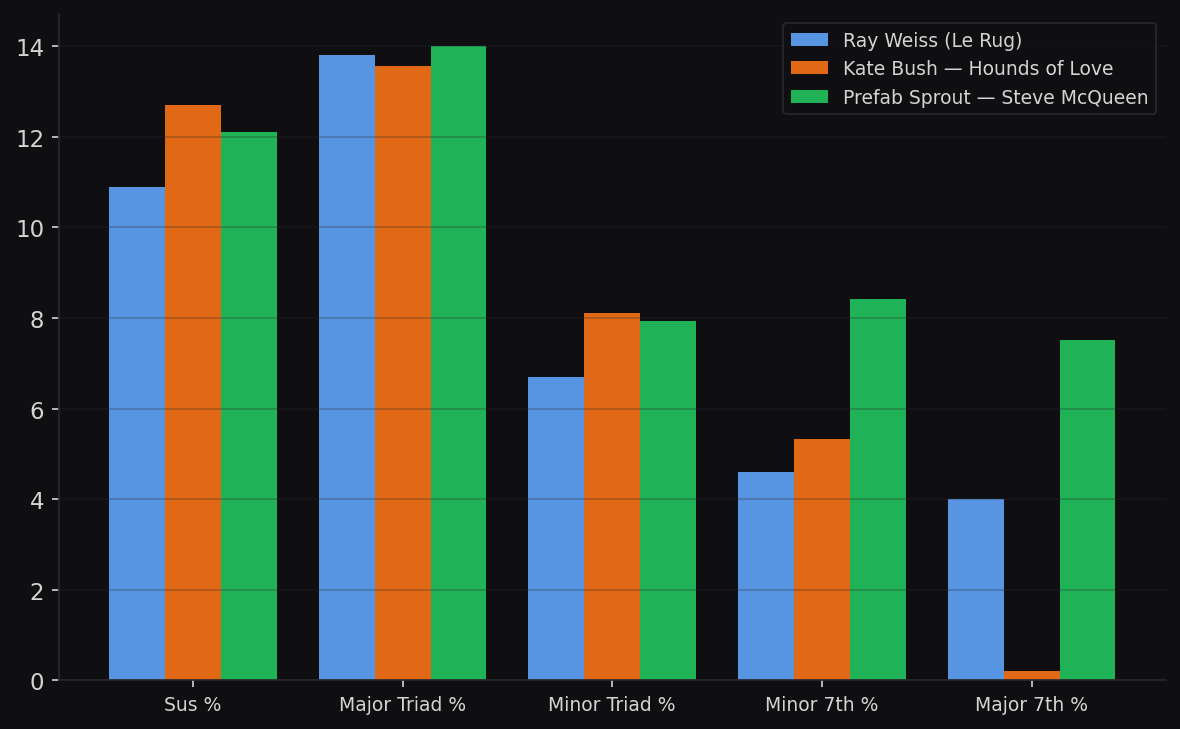
The chart makes the key Kate Bush characteristic visible: she stacks with Ray and Prefab Sprout on sus, major triad, minor triad, and minor 7th, but drops to near-zero on major 7ths. This is a distinctive jazz-extension profile — min7s without maj7s — and it matters for where Kate Bush sits in the chord-vocabulary spectrum.
The Prediction That Got Falsified
During the 2026-04-15 ear-check session, Ray’s reaction to “Waking the Witch” included the observation: “fucking fantastic track, love the bassline that hits in the verse, this shit is very good.” Based on that reaction, I predicted live, in-conversation, that Kate Bush’s register profile would likely also match Ray’s own 56% low-register dominance — that the bassline resonance would correlate with a register-level atomic match, giving the case study a second match alongside the chord-vocabulary finding.
The prediction was wrong. The data says:
| Dimension | Ray | Kate Bush | Delta |
|---|---|---|---|
| register_low_pct | 56.0 | 36.2 | -19.8 pp |
| register_mid_pct | 41.9 | 61.4 | +19.5 pp |
Kate Bush on Hounds of Love sits in the mid register (61.4%), not the low register. Ray’s catalog sits in the low register (56%). The register delta is nearly 20 percentage points — one of the largest misses in the current top-10 rankings. Ray reacted to what was exceptional in “Waking the Witch” specifically (the driving bassline), not to what the album typically does (vocals and mid-register Fairlight arrangements). The two are different things, and the fingerprint averages over the full album, so the typical wins out over the exceptional in the aggregate.
This is an honest-findings moment at the meta level. The tool’s ranking surfaced Kate Bush honestly via the chord-vocabulary distance. The listener reaction was positive and unambiguous. And when I tried to predict which other dimensions would ALSO match, I got it wrong — the register hypothesis got falsified by reading the actual data. The case study has to name this miss rather than paper over it, because the whole product philosophy is about not softening surprising or inconvenient findings. An atomic chord match with no atomic register match is still a strong result; pretending both exist when only one does would erode the trust the fingerprint is supposed to earn.
What Actually Matches
Removing the falsified register hypothesis, the structural match that remains is on the chord-vocabulary axis — and it is tight. Three chord-type dimensions and one extension dimension stack cleanly:
The major triad atomic match
| Catalog | Major Triad % | Delta vs Ray |
|---|---|---|
| Ray Weiss | 13.8% | — |
| Kate Bush — Hounds of Love | 13.57% | 0.23 pp |
| Prefab Sprout — Steve McQueen | 14.01% | 0.21 pp |
| Modest Mouse — Lonesome Crowded West | 15.9% | 2.1 pp |
Kate Bush’s major triad density is within a quarter of a percentage point of Ray’s. This joins the Modest Mouse sus match (0.44-0.50 pp) and the Prefab Sprout major triad match (0.21 pp) as the third sub-0.5pp atomic match documented in this vault. On this axis, Ray and Kate Bush are statistically indistinguishable.
The minor 7th close match
| Catalog | Minor 7th % | Delta vs Ray |
|---|---|---|
| Ray Weiss | 4.6% | — |
| Kate Bush — Hounds of Love | 5.34% | 0.74 pp |
| Prefab Sprout — Steve McQueen | 8.43% | 3.83 pp |
| Modest Mouse — Lonesome Crowded West | 1.1% | 3.5 pp |
This is actually the more interesting extension finding. Ray’s min7 density sits between the Modest Mouse foundation (1.1%) and the Prefab Sprout jazz ceiling (8.43%) — Ray at 4.6% is almost exactly midway. Kate Bush at 5.34% sits in the same midway territory as Ray, closer to Ray than to either pole. On the min7 axis, Kate Bush is the closest match in the project — tighter than either Modest Mouse or Prefab Sprout, which bracket Ray but don’t share his specific extension density.
That matters because the chord-vocabulary spectrum framing from the Prefab Sprout case study placed Ray at the midpoint of the min7 axis between two reference poles. Kate Bush now occupies a third reference point at that exact midpoint — not at a pole. The spectrum isn’t a line with Ray in the middle; it’s a neighborhood that Ray and Kate Bush both inhabit.
The sus close match
Kate Bush at 12.71% sus vs Ray’s 10.9% is a 1.81 pp delta. Not atomic, but within the same neighborhood as most of the top 10 neighbors. Sus chord density is a signature dimension, and Kate Bush’s position is consistent with the broader finding that Ray’s neighbors are sus-forward composers.
The minor triad close match
Kate Bush at 8.11% minor triad vs Ray’s 6.7% is a 1.41 pp delta. Also not atomic, also in the neighborhood.
What Doesn’t Match
Naming the misses explicitly is part of the honest-findings discipline.
Major 7ths — Kate Bush doesn’t use them
| Catalog | Major 7th % |
|---|---|
| Ray Weiss | 4.0% |
| Kate Bush — Hounds of Love | 0.21% |
Kate Bush uses almost zero major 7ths on Hounds of Love. Ray uses them at 4% density. This is a significant divergence — Kate Bush’s jazz-extension vocabulary is min7-forward without the maj7 counterpart. That’s a specific jazz-pop-hybrid style: min7s produce the modal/ambient unresolved feel, maj7s produce the classic jazz-standard feel, and Kate Bush leans heavily on the first without using the second.
This maps cleanly onto her compositional toolkit. The Fairlight CMI arrangements on Hounds of Love use sustained ambient textures that read as modal min7 / sus rather than as resolved jazz-standard progressions. Her chord vocabulary sounds sophisticated without ever sounding like classical jazz, which is exactly what the maj7 absence measures. Ray’s maj7 usage comes from a different origin — the Jesse Harris and Wes Montgomery pedagogical lineage is traditional jazz chords, including both min7 and maj7 in equal parts. Kate Bush’s min7-without-maj7 is a different path to similar sus-forward territory.
Register — Kate Bush sits in the mid range, Ray sits in the low
Already covered above as the falsified prediction. Nearly 20 percentage points of register delta. This is the largest non-maj7 miss in the Kate Bush comparison.
Mode — Kate Bush is more minor-leaning
| Dimension | Ray | Kate Bush |
|---|---|---|
| mode_major_ratio | 73.1 | 58.3 |
| scale_minor_pct | 12.0 | 50.0 |
Ray’s catalog is 73% in major keys; Kate Bush’s is 58%. Kate Bush also uses the minor scale (50% of tracks) much more than Ray does (12%). Hounds of Love is more tonally minor-leaning than Ray’s catalog — a real difference even though both catalogs share the chord-type distribution.
The Listener Reactions
Case studies in this vault have so far documented structural matches and historical context. The Kate Bush case study is the first to include real-time listener validation — Ray doing the ear-check in session while the case study was being drafted.
The reactions, preserved verbatim from the 2026-04-15 session:
On “Running Up That Hill (A Deal with God)” (first track heard):
“Holy shit — just listening to the first track, still listening more but immediately this lands for me I feel like — never really listened to her before, but already really enjoying this — her vocal work is great and this song is beautiful chord wise, I can sense why there might be some similarities, but ‘Running up that Hill’ is fantastic so far, embarrassed I hadn’t listened to this sooner.”
Later, after more tracks:
“So far very much enjoying Kate Bush — compared to other contemporary artists around her period her melodies/chord choices are far more interesting than most.”
On “Waking the Witch” (the Ninth Wave track that prompted the register prediction):
“Just hit Waking the Witch — fucking fantastic track, love the bassline that hits in the verse, this shit is very good.”
Summary after the full ear-check sample:
“Got a good rep, only a couple songs from the album but I really enjoyed every one — Running up that Hill, Hounds of Love, Big Sky, Mother Stands for Comfort, Cloudbusting and Waking the Witch.”
Six tracks across both Side A (the pop side) and the Ninth Wave (the experimental side), with positive reactions on every track. The sample ran through the album’s stylistic range: straight-pop opener, title-track rocker, more experimental pop, confessional ballad, string-arranged pop, and Fairlight-driven experimental. The match survived every category.
Why the reactions matter as evidence
The listener validation is separate from the structural match and carries distinct weight. The 3-dim distance metric can rank Kate Bush at #2 based on chord-type percentages alone. That’s a methodological claim about chord vocabulary. The listener reaction is a claim about whether the composer recognizes the resonance from hearing the music itself. Both claims can hold independently; both holding simultaneously is the strongest possible result.
The specific detail that matters most: Ray had never listened to Kate Bush before, and the first-track reaction was immediate. That’s prospective discovery in the cleanest possible form. The tool said “this should resonate with you”; the listener listened; the resonance landed on the first track, unprompted, without prior expectation, and held across every subsequent track. The “embarrassed I hadn’t listened to this sooner” line is the honest-findings philosophy working at the listener level — the tool surfaced a genuine music-listener gap and filled it.
This is a different mode of validation than the Dead or Alive finding (where Ray had covered the artist previously) or the Modest Mouse finding (where Ray named them as a rip-off source). Kate Bush is a zero-prior discovery: no existing relationship, no stated influence, no pre-tool recognition. The tool produced the recommendation from structural data alone, and the listener subsequently validated it as music worth loving independently of the analysis.
The Harmonically Distinctive Outlier Framing
Ray’s own observation during the ear-check — that Kate Bush’s “melodies/chord choices are far more interesting than most” of her contemporaries — maps directly onto the structural data. Kate Bush in 1985 was a mid-80s pop artist, and her chord vocabulary does not resemble the mid-80s pop chord vocabulary of her contemporaries. It resembles a more harmonically sophisticated songwriting tradition: sus-forward, modal, min7-extended, unresolved in places where radio-era pop would resolve.
The 1985 cluster around Ray’s catalog contains exactly two albums: Prefab Sprout — Steve McQueen (#1) and Kate Bush — Hounds of Love (#2). Both are 1985 releases. Both were produced outside the dominant radio-pop aesthetic of their year. Both were critical and commercial successes that nonetheless sounded one step sideways from their era’s mainstream.
This is not a coincidence. The pattern suggests the Ray-neighborhood on the chord-vocabulary axis is specifically a neighborhood of harmonically distinctive outliers, not a neighborhood defined by era or genre. Steve McQueen and Hounds of Love both live in a harmonic space that was unusual for 1985 and is unusual for any pop year — their shared trait is distinctiveness against their peers, not stylistic similarity to each other. Ray lives in the same space, for reasons that have nothing to do with 1985 (Ray was not yet writing music in 1985) and everything to do with compositional instincts that converge on the same chord-vocabulary shape from different directions.
The Big Country and John Cale Cross-References
During the same 2026-04-15 ear-check session, Ray surfaced two additional artists as cross-references he was hearing while listening to Hounds of Love. Both are documented here as research observations and both are queued for reference DB population in the next bot run.
Big Country
Ray flagged Big Country’s early period (The Crossing 1983, Steeltown 1984, The Seer 1986) as music he was hearing Kate Bush-adjacent similarities to. Context from Ray’s own 2026-04-15 session comments:
- Big Country was a previously-unmentioned formative influence
- “Hearing Inwards for the first time was one of those moments where I really thought I heard myself in the work” — Ray’s own prospective self-recognition experience from before the tool existed
- Kate Bush guest-vocaled on the title track of The Seer (1986), making Kate Bush and Big Country direct collaborators via that record
- Ray emulated Stuart Adamson (Big Country’s frontman and guitarist) aesthetically to a significant degree. Independent third-party confirmation: the Iron Sheik (professional wrestler) roasted Ray on Facebook around 2016 with the line “you look like the jabroni from Big Country” (Ray paid $40 for the roast)
The self-recognition and emulation elements complicate each other. The clean ordering would be: hear Inwards, experience self-recognition, adopt the aesthetic, emulate. If that’s the order, then the structural similarity pre-dates the conscious emulation and Big Country’s future fingerprint match to Ray remains self-recognition evidence. But some portion of the match could include habits Ray absorbed during the emulation phase. When Big Country populates, this needs explicit treatment rather than clean framing.
John Cale — Artificial Intelligence
Ray also flagged Cale’s Artificial Intelligence (1985, Beggars Banquet) as another cross-reference. Specific song memory: “Dying on the Vine,” which is the 1985 UK single from Artificial Intelligence. Ray described the album cover as “abstract/modern art esque” and wasn’t sure which Cale album it was from until web search confirmed it. Like Big Country, Cale was a previously-unmentioned formative influence — the fifth to surface in 48 hours, alongside Smiths, Felt, Prefab Sprout, and Big Country.
The cluster hypothesis
If Kate Bush (#2 at 2.26), Big Country early period, and John Cale Artificial Intelligence all land in the top 15-20 of Ray’s reference DB after population, that’s evidence for a coherent chord-vocabulary neighborhood around Ray, not an arbitrary ranking with Kate Bush as an outlier. The specific falsifiable claim: Big Country + John Cale will cluster closer to Kate Bush’s chord vocabulary than to the median 148-entry distance. The next populate run will test this. If the claim holds, the Kate Bush case study’s harmonically-distinctive-outlier framing widens from “the 1985 cluster” to “the sus-forward, min7-rich, modal-leaning mid-80s art-pop neighborhood that Ray landed in without knowing it was there.”
Context — The Never-Heard-It Data Point
Kate Bush is the first case study in this vault where the artist was a zero-prior discovery. Ray had never listened to Kate Bush before the 2026-04-15 session. The structural ranking placed her at #2 based on chord-vocabulary data alone. The listener then confirmed the match by hearing music he loved without having been exposed to it previously.
This is a different value proposition than the other case studies deliver. Dead or Alive showed Ray a surprising similarity to an artist he had covered but dismissed. Modest Mouse showed Ray a mathematical confirmation of a self-reported rip-off source. Prefab Sprout showed Ray that his stated influence list was incomplete in the sophisticated-chord direction. Kate Bush shows something different: the tool can produce listener-worthy music recommendations for people who haven’t encountered the music yet.
For the product’s eventual positioning as a discovery engine, this is the case the tool needs. “Here is music you’d love, that you haven’t heard, selected based on how you actually compose” is a stronger sales pitch than “here is music you already know you like, ranked by similarity to your catalog.” The Kate Bush finding is the first concrete demonstration that the stronger pitch works: produce the recommendation, play the music, watch the listener fall in love with it.
Caveats
The ear-check sample was incomplete
Ray’s listening sample was 6 of 12 tracks: Running Up That Hill, Hounds of Love, The Big Sky, Mother Stands for Comfort, Cloudbusting, and Waking the Witch. The missing 6 tracks are most of the Ninth Wave suite: And Dream of Sheep, Under Ice, Watching You Without Me, Jig of Life, Hello Earth, and The Morning Fog. The verdict held across the sample Ray heard, but the full album’s Ninth Wave content (which contains the most experimental material) was not directly validated track-by-track. The aggregate fingerprint was computed from the full 12-track album from the reference DB population run.
The register miss is not nothing
A 19.8 percentage point register delta is a genuine structural divergence. The chord-vocabulary match is real, but the Kate Bush case study should not be read as a full-fingerprint match the way the Bowie Low Side A finding was. The 22-dimensional variance-weighted distance to Kate Bush is not as tight as the 3-dim chord-vocabulary distance suggests.
The max7 absence is a categorical divergence
Kate Bush uses 0.21% major 7ths; Ray uses 4.0%. That’s not a small delta — it’s nearly zero versus meaningful. Ray’s maj7 usage is one of the more distinctive features of his own chord vocabulary (from the Harris / Montgomery pedagogical lineage), and Kate Bush lacks it entirely. The case study’s chord-vocabulary match should be read as “matches the sus / major triad / min7 neighborhood” not “matches the full extended chord vocabulary.”
The listener-level evidence is N=1
One artist’s positive reaction to one album is not a pattern. For the discovery-engine thesis, the Kate Bush finding is the first data point. More listeners and more tool-produced discoveries would be needed to establish whether “tool produces music you’d love that you hadn’t heard” generalizes beyond this single instance.
The 2.26 ranking may shift with DB growth
As the reference DB grows (Big Country and John Cale are queued for next populate run), Kate Bush’s rank may shift. The 2.26 distance itself shouldn’t change, but the rank position could move up or down depending on whether newly-populated entries score closer or further. The claim “Kate Bush is the #2 match” is true as of 2026-04-15 and may not survive future population passes.
Tracks in the Reference DB Aggregate
The 148-entry ranking used a 12-track Hounds of Love sample via the canonical YouTube Music OLAK5uy_ topic playlist. Full track listing for the album:
Side A (the pop side):
- Running Up That Hill (A Deal with God)
- Hounds of Love
- The Big Sky
- Mother Stands for Comfort
- Cloudbusting
Side B — The Ninth Wave suite:
- And Dream of Sheep
- Under Ice
- Waking the Witch
- Watching You Without Me
- Jig of Life
- Hello Earth
- The Morning Fog
Ray’s listening sample covered all 5 Side A tracks plus Waking the Witch from Side B. The reference DB aggregate uses all 12 tracks.
Analysis pipeline: basic-pitch MIDI extraction, music21 harmony enrichment, per-track and per-album fingerprint aggregation, 3-dim chord-vocabulary distance computation against the 148-entry reference DB as of 2026-04-15.
Related case studies in this vault: Prefab Sprout — Steve McQueen (the #1 match and the other 1985 cluster anchor), Modest Mouse — The Chord Vocabulary Home (the foundation pole of the chord-vocabulary spectrum), Bowie — Low (the within-album self-recognition finding). All four sit within the broader chord-vocabulary ranking at The Full Comparison Map.