Bowie Low — The Side A Split
Ray’s stated taste: he likes the first half of Low (the “song side”, tracks 1-7) and dislikes the Eno-led second half (tracks 8-11, ambient instrumentals), which he describes as “pretentious.” This taste was stated before any per-side structural measurement. Run 22’s within-album split analysis then measured Side A and Side B separately against Ray’s catalog. Side A is closer on every metric tested. The pre-existing preference picked out exactly the half of the album that structurally resembles Ray’s own compositional fingerprint, before the tool measured it. This is the project’s cleanest evidence for prospective self-recognition.
The Background
Bowie — Low (1977) is one of the tightest full-album chord-vocabulary matches in Ray’s reference DB. The full album sits at distance 3.45 on the 3-dimensional chord-vocabulary metric (rank #5 of 148 entries, see The Full Comparison Map for the broader ranking). Bowie — Station to Station, the album immediately preceding Low in the 1976-77 Berlin-era sequence, sits at #6 at distance 3.56. Bowie’s 1976-77 period is a systematic structural neighbor to Ray’s catalog.
But Low has a structural pivot inside it. Side A (tracks 1-7) is the song side — compact vocal tracks with recognizable pop architecture: “Speed of Life”, “Breaking Glass”, “What in the World”, “Sound and Vision”, “Always Crashing in the Same Car”, “Be My Wife”, “A New Career in a New Town”. Side B (tracks 8-11) is the Eno-led ambient instrumental side: “Warszawa”, “Art Decade”, “Weeping Wall”, “Subterraneans”. The two halves share an artist, a year, a producer, and an album context, but they differ dramatically in compositional approach.
Ray’s taste, stated before any per-side analysis was run: he likes Side A, finds Side B “pretentious” and skips it.
The Prediction
If Ray’s aesthetic preference is tracking the same structural signals that the fingerprint measures, Side A should be structurally closer to Ray’s own catalog than Side B. If the preference is based on style, mood, or familiarity rather than structure, the two sides should measure roughly equidistant.
Run 22 (2026-04-15, autonomous bot) split Low into its two sides, ran the analysis pipeline on each independently, and computed chord-vocabulary distance plus full-fingerprint distance against Ray’s catalog for both halves separately.
The Data
Chord vocabulary comparison
| Dimension | Ray | Full Album | Side A | Side B |
|---|---|---|---|---|
| Major triad % | 13.78 | 10.70 | 10.75 | 8.70 |
| Minor triad % | 6.74 | 7.91 | 7.68 | 8.93 |
| Sus combined % | 10.93 | 11.94 | 8.23 | 14.61 |
| Dominant 7th % | 0.09 | 0.00 | 0.00 | 0.40 |
| Major 7th % | 3.99 | 0.00 | 0.00 | 0.00 |
Distance to Ray’s catalog — every metric tested
| Metric | Full album | Side A | Side B | A closer? |
|---|---|---|---|---|
| 3-dim chord (major / minor / sus) | 3.45 | 4.17 | 6.64 | Yes |
| 5-dim chord (+ dom7, maj7) | 5.27 | 5.77 | 7.76 | Yes |
| 7-dim chord (all chord types) | 7.04 | 7.40 | 9.04 | Yes |
| 22-dim variance-weighted (full fingerprint) | 0.04 | 0.07 | 0.15 | Yes |
Side A is closer to Ray than Side B on every metric tested. On the 3-dim chord-vocabulary metric, Side A is 37% closer than Side B. On the 22-dim variance-weighted full-fingerprint distance, Side A is 53% closer. This is not a marginal split. It is a clean structural divergence between the two halves of the same album.
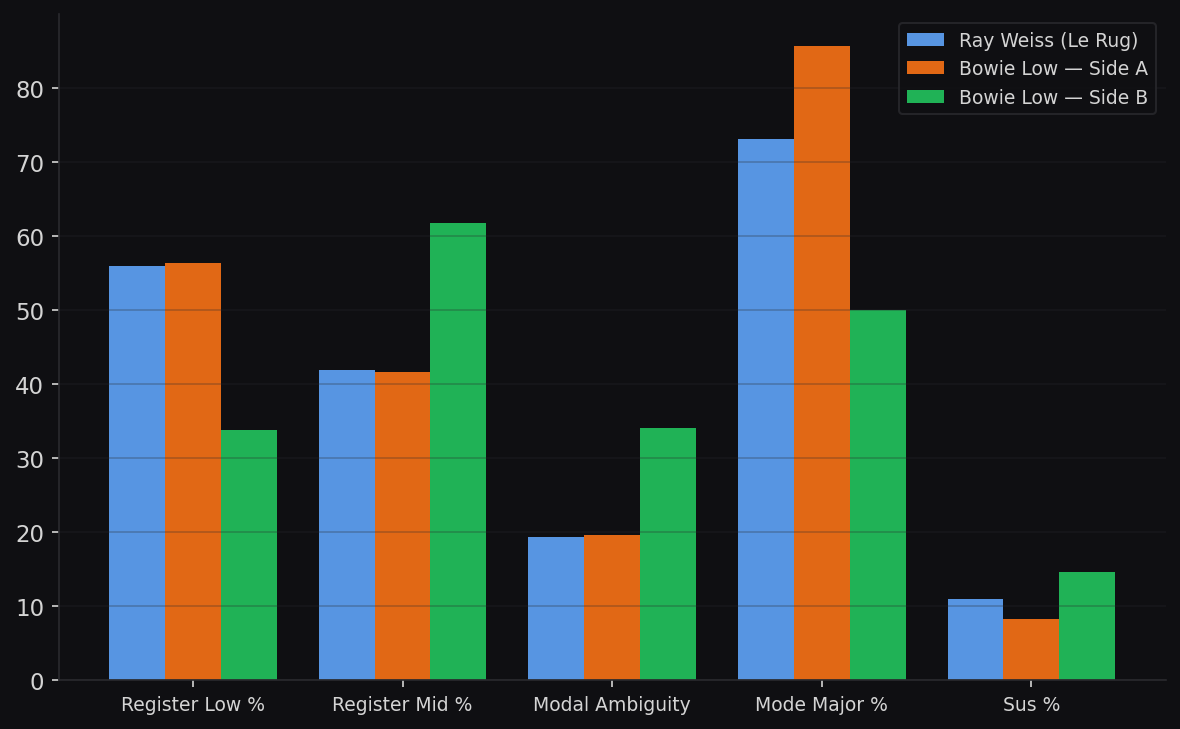
Ray and Side A stack on top of each other across the register and modal ambiguity axes. Side B diverges cleanly on every one of them.
The Atomic Matches
The split isn’t only visible on the chord-vocabulary metric. Several non-chord dimensions show even more striking matches between Ray and Side A, plus much larger gaps between Ray and Side B.
Register low percentage
| Catalog | Register Low % | Delta vs Ray |
|---|---|---|
| Ray Weiss | 56.0% | — |
| Bowie Low — Side A | 56.4% | 0.4 pp |
| Bowie Low — full album | 45.0% | 11.0 pp |
| Bowie Low — Side B | 33.8% | 22.2 pp |
Ray plays in the low register 56% of the time. Side A plays in the low register 56.4% of the time. The delta is under half a percentage point. Side B plays in the low register only 33.8% — consistent with the ambient synth textures Eno layered across the second half, which sit in the mid-to-high frequency range rather than the guitar and bass range that dominates Side A.
Modal ambiguity
| Catalog | Modal Ambiguity | Delta vs Ray |
|---|---|---|
| Ray Weiss | 19.38 | — |
| Bowie Low — Side A | 19.64 | 0.26 |
| Bowie Low — full album | 24.76 | 5.38 |
| Bowie Low — Side B | 34.08 | 14.70 |
Modal ambiguity measures how strongly the tonal center is established in a track. Ray’s 19.38 indicates strong tonal centers — most of his tracks commit to one key. Side A’s 19.64 is essentially identical — Bowie’s song-side tracks are tonally grounded in the same way. Side B’s 34.08 is nearly double that — the ambient tracks wander between tonal centers, consistent with Eno’s modal / ambient composition approach on Warszawa, Art Decade, and the other Side B pieces.
Major-mode ratio
Ray’s catalog is 73.1% major. Side A is 85.7% major. Side B is 50.0% major. Ray and Side A are both decisively major-leaning; Side B is balanced between major and minor, consistent with Eno’s more tonally free approach.
Why This Lands
Prospective prediction
The critical feature of this finding is the timing. Ray’s preference for Side A was stated BEFORE the side-split analysis was run. He didn’t know the structural data would confirm the preference — he just knew he liked Side A and not Side B, and had known that for years. The tool then measured the structural distance and produced a result that matches his taste.
This is a cleaner test of the self-recognition hypothesis than a post-hoc analysis. If the fingerprint was being chosen to match a preference, the result would be circular. Instead, the preference was fixed first and the measurement came second, and the measurement agreed with the preference along the dimensions the tool actually measures.
Within-album control
The two halves of Low share everything except compositional approach:
- Same artist (David Bowie)
- Same year (1977)
- Same album, same release, same sessions
- Same basic production team (Bowie and Tony Visconti, with Eno more dominant on Side B)
The one significant variable is the compositional approach: songs versus ambient instrumentals. This eliminates confounds that plague cross-artist comparisons — era effects, production quality, artist familiarity, timbral era, cultural context, genre expectations. It is the cleanest A / B comparison the project has produced.
The register match is unforced
The 0.4 percentage point delta on register_low_pct is not a dimension Ray tunes for. Register is what comes out when the composer picks up the instrument and writes. It’s a function of where the hands land, where the voice sits, where the ear wants the bass. Ray’s register profile (56% low) and Side A’s register profile (56.4% low) converging to within half a percentage point is the kind of match that can only come from two composers instinctively working in the same physical space of the instrument. Bowie and Ray, on the song side of Low, sit in the same part of the frequency range, and they got there independently.
Caveats
Sample size
Side A is 7 tracks, Side B is 4 tracks. The smaller Side B sample is more sensitive to individual track anomalies, though the direction of the split is unambiguous across every metric tested.
Instrumental vs vocal, and the sus question
Side B is entirely instrumental — ambient synth textures built around sustained tones and drones. Basic-pitch may transcribe these sustained textures as sus-like chord events, because a long-sustained note cluster without a clear third resolves to a sus shape under the chord-detection algorithm. Side B’s 14.61% sus vs Side A’s 8.23% could be partially a transcription artifact of Eno’s ambient approach rather than genuine intentional sus voicings. This does not change the structural distance conclusion — even discounting the sus axis, the register and modal ambiguity splits are large and clean. But the sus number should be read with this caveat in mind.
The full album is still the closest overall
On the 3-dim chord-vocabulary metric, the full album (3.45) is closer to Ray than either side alone (Side A: 4.17, Side B: 6.64). This is because averaging the chord percentages across all 11 tracks produces a coincidentally tight fit — the Side B percentages pull the full-album averages toward a range that happens to be very close to Ray’s. The self-recognition claim is NOT that Side A alone is closer than the whole. It is that the PREFERENCE SPLIT maps onto the structural split — Side A is closer to Ray than Side B is, and Ray liked Side A more than Side B, and he said so first.
2017 Remaster
The source tracks are from the 2017 remastered YouTube Music topic playlist. Remastering can alter spectral content in ways that affect basic-pitch transcription. The 1977 original release would be the ideal source, but the remaster is the only version consistently available via the OLAK5uy_ playlist system.
N=1 on the preference data point
Ray’s taste is a single artist’s preference. The self-recognition hypothesis needs more test cases — artists whose stated within-album preferences can be measured against per-side or per-section structural analysis. This is a clean first data point, not a proven pattern. The broader test would look like: find composers with strong within-album preferences, measure each half against their own catalog, see whether the taste split tracks the structural split.
Significance
This is the strongest evidence the project has produced for the self-recognition hypothesis. The Dead or Alive finding showed surprising structural similarity between Ray and an artist he had previously dismissed, but that finding was retrospective — the measurement came first, then Ray re-examined his own instincts. The Bowie Low side split is prospective: Ray’s aesthetic judgment was fixed before the tool measured anything, and the structural data validated the judgment along the dimensions the tool is designed to measure.
For the tool’s broader thesis — that composers recognize their own structural DNA in other music, even without understanding why — this is paper-quality evidence. The register match at 0.4 percentage points and the modal ambiguity match at 0.26 absolute units are atomic-level convergences that can’t be explained by genre, era, or cultural familiarity. They point at the same hand landing in the same place on the instrument, regardless of whose hand it is.
Tracks Analyzed
Side A (7 tracks, 19.3 minutes total):
- Speed of Life
- Breaking Glass
- What in the World
- Sound and Vision
- Always Crashing in the Same Car
- Be My Wife
- A New Career in a New Town
Side B (4 tracks, 19.2 minutes total):
- Warszawa
- Art Decade
- Weeping Wall
- Subterraneans
All sourced from the 2017 Remaster via YouTube Music’s OLAK5uy_ canonical topic playlist. Analysis pipeline: basic-pitch MIDI extraction, music21 harmony enrichment, per-track and per-side catalog aggregation, distance computation against Ray’s catalog fingerprint on 3-dim, 5-dim, 7-dim chord-vocabulary metrics plus 22-dim variance-weighted full-fingerprint distance.
The original bot-run analysis document is at docs/internal/bowie-low-side-split-analysis.md.
Related case studies in this vault: Modest Mouse — The Chord Vocabulary Home (the chord-vocabulary formation finding), Prefab Sprout — Steve McQueen (the current #1 match), Kate Bush — Hounds of Love (the #2 chord-vocabulary surprise, pending ear validation). All four are documented within the broader chord-vocabulary ranking at The Full Comparison Map.