Drum Analysis
Separated drum stems via Demucs (Meta’s AI source separation) and analyzed for onset density, rhythmic regularity, spectral balance, and complexity. Sample of 11 tracks across 5 eras.
The Big Finding: Two Completely Different Drum Philosophies
The data reveals a clear split between the double-drum band era (Bleenex through Nuke Whales) and the solo era (Dead In A Hole onward). These aren’t just different in sound — they’re structurally opposite.
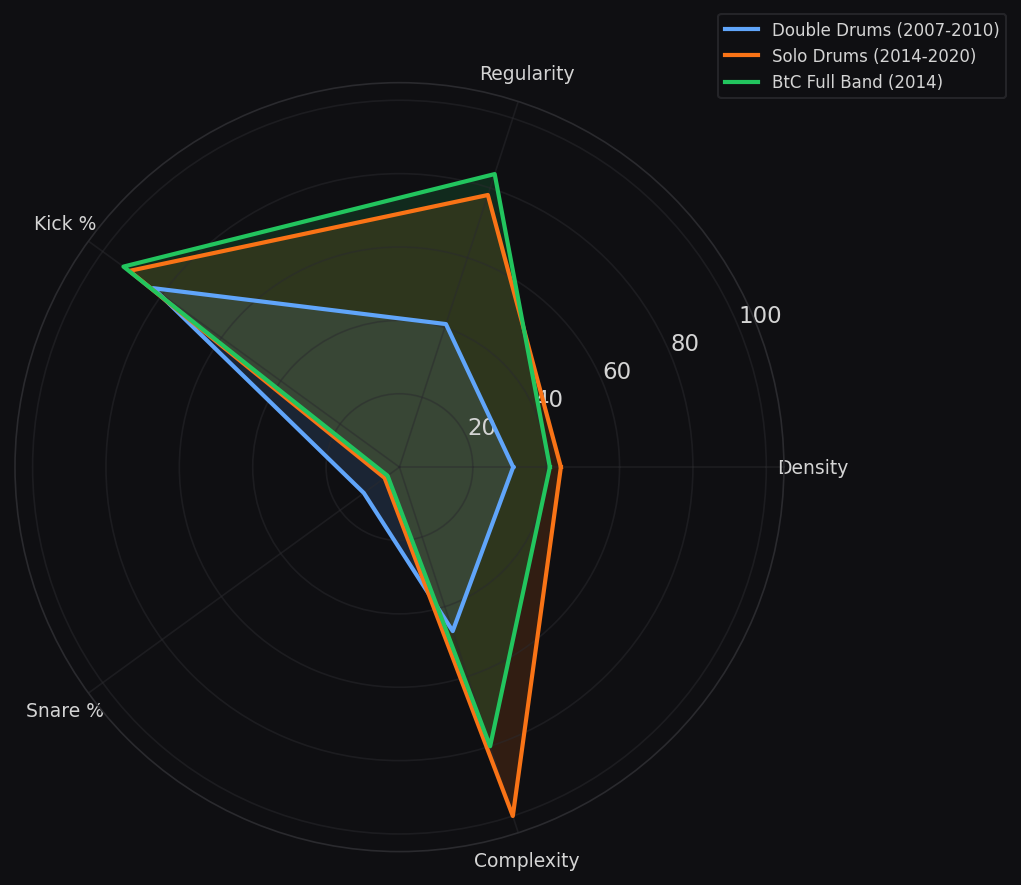
Radar values normalized to 0-100 scale for visual comparison.
| Metric | Double Drums (2007-2010) | Solo Drums (2014-2020) | BtC / Full Band (2014) |
|---|---|---|---|
| Drum density | 3.1 hits/sec | 4.4 hits/sec | 4.1 hits/sec |
| Regularity | 0.41 (loose) | 0.78 (tight) | 0.84 (tightest) |
| Kick dominance | 83% | 91% | 93% |
| Snare presence | 12% | 5% | 4% |
| Rhythmic complexity | 7 tempo peaks | 15 tempo peaks | 12 tempo peaks |
Double drums = loose, groovy, snare-heavy, simple patterns. Solo drums = tight, dense, kick-heavy, complex patterns. BtC full band = tightest of all. Jordyn Blakely with Jesse Harris producing — professional session discipline creates the most metronomic drumming in the catalog.
What This Means
1. The Looseness Was The Point
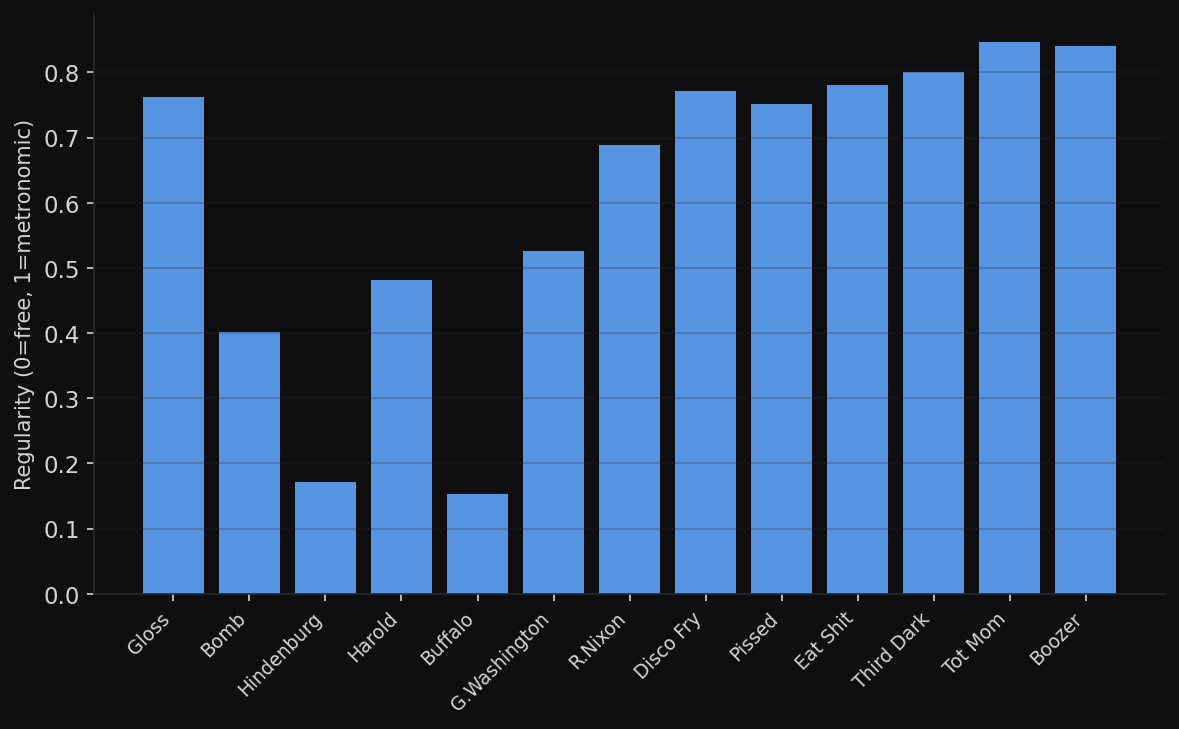
The double-drum records have regularity scores of 0.15-0.53 — this is genuinely loose timing. Two drummers playing together create natural human inconsistencies that give the music a swaying, alive quality. SRF’s Buffalo (0.153) is the loosest — practically free-time drumming. Bleenex’s Hindenburg (0.172) is similarly untethered.
By contrast, DIAH and ABH hover around 0.77-0.80 — much more metronomic. When Ray programs or plays drums alone, the timing tightens up. Whether this was deliberate or just the nature of one person vs. two, the feel changed dramatically.
2. The Kick Drum IS The Drums
Across all eras, kick drum energy dominates: 80-92% of spectral energy is in the sub-200Hz range. Hi-hat and cymbal work is minimal (3-6%). This is an unusual balance — most rock drumming has more cymbal presence. The result is a low-end-heavy, pounding rhythmic foundation that complements the bass-heavy guitar register rather than sitting on top of it.
The snare is more prominent in the double-drum era (10-17%) and nearly disappears in the solo era (4-6%). Two drummers meant more snare hits occupying the mid-frequency space; solo drums lean even further into kick-dominant patterns.
3. Programmed Drums Are More Complex
Counterintuitively, the solo-era drums have 2x the rhythmic complexity (measured by tempo peaks in the tempogram). This makes sense: when programming drums, Ray can layer precise cross-rhythms and pattern changes that two humans would struggle to maintain. The double-drum era relies on groove and feel rather than intricate patterns.
DIAH’s “Disco Fry” scores 21 tempo peaks — the most complex rhythmic track in the sample. This is a solo-composed track where Ray controls every element and can build interlocking drum patterns deliberately.
Per-Track Results
| Track | Era | Hits/s | Tempo | Regularity | Kick% | Snare% | Hat% | Complexity |
|---|---|---|---|---|---|---|---|---|
| Bleenex - Gloss | 2007 | 3.2 | 161.5 | 0.763 | 88 | 5 | 6 | 8 |
| Bleenex - Bomb | 2007 | 3.3 | 143.6 | 0.401 | 91 | 6 | 4 | 10 |
| Bleenex - Hindenburg | 2007 | 2.6 | 129.2 | 0.172 | 88 | 8 | 4 | 4 |
| SRF - Harold Camping | 2008 | 3.0 | 117.5 | 0.482 | 87 | 10 | 3 | 8 |
| SRF - Buffalo | 2008 | 2.7 | 123.0 | 0.153 | 82 | 13 | 6 | 8 |
| Nuke - George Washington | 2010 | 3.6 | 68.0 | 0.526 | 80 | 17 | 4 | 6 |
| Nuke - Richard Nixon | 2010 | 3.9 | 117.5 | 0.688 | 80 | 16 | 4 | 6 |
| DIAH - Disco Fry | 2014 | 4.8 | 136.0 | 0.771 | 92 | 5 | 4 | 21 |
| DIAH - Pissed | 2014 | 3.6 | 123.0 | 0.752 | 88 | 6 | 6 | 11 |
| ABH - Eat Shit City | 2020 | 4.7 | 78.3 | 0.781 | 92 | 4 | 4 | 12 |
| ABH - Third Dark Age | 2020 | 4.7 | 89.1 | 0.800 | 90 | 5 | 6 | 15 |
| BtC - Tot Mom | 2014 (BtC) | 4.3 | 152.0 | 0.847 | 93 | 5 | 3 | 12 | | BtC - Boozer | 2014 (BtC) | 4.0 | 123.0 | 0.840 | 93 | 4 | 3 | 12 |
Note: Demucs tempo estimates differ from the pitch-based tempo detection because they’re measuring different things — the drum tempo is derived from the isolated percussion pattern, while the melodic tempo includes guitar/bass rhythm.
Regularity Over Time
By Era
Bleenex (2007) — Double Drums
3.0 hits/sec | 0.445 regularity | 89/6/5 K/S/H
Moderate density, wildly varying regularity. Gloss (0.763) is the tightest Bleenex drum track — possibly because the 17.2 n/s guitar density demanded a more stable rhythmic foundation. Hindenburg (0.172) is the loosest — the drums are practically stumbling, creating a chaotic energy that complements the closing track’s intensity.
Sex Reduction Flower (~2008) — Double Drums
2.9 hits/sec | 0.318 regularity | 84/12/4 K/S/H
The LOOSEST drumming in the catalog. Two tracks averaging 0.318 regularity means the drummers were playing in a flowing, non-metronomic style. More snare presence (12%) gives these tracks a brighter percussive character. This era’s shoegaze influence may have extended to the drums — looser, more textural, less driving.
Nuke Whales (~2010) — Double Drums
3.8 hits/sec | 0.607 regularity | 80/16/4 K/S/H
The drums tighten up for the miniature-song format. With 44 tracks under 60 seconds each, the drumming needs to establish feel quickly — no room for gradual loosening. Most snare-prominent era (16-17%), and lowest kick dominance (80%). The constraint of short songs may have pushed the drummers toward more traditional rock patterns with clearer snare backbeats.
Dead In A Hole (2014) — Solo
4.2 hits/sec | 0.762 regularity | 90/6/5 K/S/H
The switch to solo drums brings a dramatic regularity increase. Disco Fry at 21 complexity peaks is the most rhythmically intricate track sampled — Ray composing drum parts without the constraint of another human. Kick dominance jumps to 90%; snare drops to 6%. The drum character shifts from “groove” to “drive.”
Anyone But Hindenburg (2020) — Solo
4.7 hits/sec | 0.790 regularity | 91/4/5 K/S/H
The densest, tightest, most kick-dominant drumming. 4.7 hits/sec is 60% denser than the Bleenex-era drums. Regularity at 0.790 is the tightest. The drums have become a precision instrument — tight and propulsive, serving the increasingly dense guitar work.
Butter the Children — True Crime (2014) — Full Band, Single Drummer
4.1 hits/sec | 0.844 regularity | 93/4/3 K/S/H
The tightest drumming in the entire catalog. Jordyn Blakely on drums, Jesse Harris producing, Pat Dillett engineering. Professional session context produces the most metronomic feel — regularity of 0.844 exceeds even the programmed solo drums. The kick dominance (93%) is also the highest. This is what Le Rug sounds like with studio discipline applied: the looseness that defined the double-drum era is gone, replaced by precision.
Interesting comparison: BtC True Crime and Le Rug Dead In A Hole are both from 2014, both dense, but drumming-wise they’re different animals. DIAH is more rhythmically complex (16 tempo peaks vs. 12) but less regular (0.762 vs. 0.844). Ray programming his own drums creates more pattern variety; a pro drummer creates tighter grooves.
Implications for the AI Tool
The drum data adds a new dimension to the “Ray Weiss fingerprint”:
- Double-drum records need loose, human-feeling patterns with higher snare presence
- Solo records need tighter, kick-dominant patterns with more rhythmic complexity
- Across all eras: Kick drum dominates, cymbals are minimal, the drums sit low in the frequency spectrum alongside the bass-heavy guitar
Method Notes
Separation: Demucs (htdemucs model, two-stem drums/no-drums mode). Analysis: librosa onset detection, beat tracking, spectral analysis, tempogram complexity. 13 tracks sampled from 6 eras (Bleenex, SRF, Nuke Whales, DIAH, ABH, BtC True Crime).
Limitations: Demucs separation isn’t perfect — some guitar bleed into drum stems and vice versa may affect spectral balance measurements. The kick dominance numbers may be partially inflated by bass guitar bleed. The onset detection and regularity measurements are more robust as they depend on transient detection rather than spectral content.