Chapter 12: Victory Conditions
Victory conditions define what the game is about. You can build a CRT that produces historical casualty rates, a map that captures every ridge and river crossing, and a sequence of play that models command friction at every echelon. None of it matters if the players do not know what they are trying to accomplish or if the objectives you give them bear no relationship to the historical situation. Victory conditions are the contract between the designer and the player. They tell the player what to optimize for, and in doing so, they shape every decision the player makes from the first turn to the last.
I have seen designers treat victory conditions as an afterthought, something bolted onto the game after the systems are built. That is backwards. Victory conditions should be among the earliest design decisions because they determine what the rest of the game needs to support. A game where victory depends on territorial control needs a map where territory matters and a combat system where taking and holding ground produces results. A game where victory depends on inflicting casualties needs a combat system with enough granularity to differentiate between a pyrrhic win and a clean one. The systems serve the victory conditions. If you design the systems first and then try to figure out what “winning” means, you will end up with objectives that do not connect to the game the player has been playing for the last three hours.
What Victory Conditions Do
Victory conditions do three things in your design. They give the player an objective to pursue, they create a framework for evaluating how well the player performed, and they make an argument about what mattered in the historical conflict.
The third function is the one designers overlook most often. When you write victory conditions for a game about Gettysburg, you are deciding what mattered at Gettysburg. If the Confederate player wins by occupying Cemetery Hill, you are arguing that the battle hinged on terrain. If the Confederate player wins by destroying a certain number of Union strength points, you are arguing that the battle hinged on attrition. If the Confederate player wins by exiting units off the map toward Washington, you are arguing that the battle was about Lee’s strategic objective of threatening the capital. These are different arguments, and they produce different games. The victory conditions do not just end the game. They tell the player what the game was about.
This is why victory conditions need to come from your research, not from generic design templates. “Control X hexes” is a structure, not a victory condition. The historical context tells you which hexes matter and why. “Destroy X strength points” is a structure. The historical context tells you what level of losses would have changed the outcome. Your victory conditions should reflect what the historical commanders were trying to accomplish, adjusted where necessary to produce a playable game.
Territorial Victory Conditions
The simplest and most common type. One or both players need to control specific locations on the map by the end of the game or by a certain turn. Cities, crossroads, bridges, ports, supply centers.
Territorial victory works well when the historical conflict was about controlling ground. Most operational games use territorial victory because campaigns are fought over geography. The German player in a Barbarossa game needs to capture Moscow, or Leningrad, or the Caucasus oil fields. The Allied player in a Normandy game needs to secure the beachhead and break out. These objectives mirror the historical mission.
The risk with territorial victory is that it can reduce the game to a race toward a hex, ignoring the historical dynamics that made reaching that hex difficult. If the only thing that matters is whether the German player sits on the Moscow hex at the end of turn 12, then every German decision reduces to “what gets me closer to Moscow fastest?” The historical campaign was more complicated than that. Army Group Center had to protect its flanks, maintain supply lines, deal with Soviet counterattacks, and manage the deteriorating condition of its panzer divisions. Your victory conditions should reward the player for handling those problems, not just for reaching a hex.
One solution is to require the player to hold territory with adequate force rather than just touching it with a single unit. If Moscow must be controlled by at least three divisions in supply, the German player cannot strip the front bare to rush a token force into the city. Another solution is to include negative conditions: the German player loses points for Soviet-controlled hexes behind their front line, representing the historical threat of partisan activity and bypassed garrisons.
Point-Based Victory Conditions
Victory points allow you to weight multiple objectives and create a composite score that reflects overall performance. The player earns points for capturing territory, destroying enemy units, achieving specific objectives by specific turns, or meeting political conditions. The player with the most points at the end wins, or the player who crosses a VP threshold triggers an automatic victory.
Point-based systems give you more granularity than territorial victory. You can assign 5 VP to a critical city and 1 VP to a secondary crossroads. You can award VP for destroying an elite formation and no VP for destroying a garrison unit. You can penalize a player for losing their own elite units. The VP schedule becomes a priority list that guides the player’s decisions.
The danger of VP systems is complexity. A game with thirty different VP triggers scattered across the map and the turn track asks the player to hold too many objectives in their head at once. The best VP systems are simple enough that a player can evaluate their position at a glance. Am I ahead or behind? What is the most valuable objective I can reach with the forces I have? If the player needs a calculator to figure out whether they are winning, the VP system is too complicated.
VP systems also create a temptation for the designer to fix balance problems by adjusting point values rather than fixing the underlying mechanics. If the German player wins too often, the instinct is to increase the VP cost of their objectives or decrease the VP value of their conquests. This can work, but it can also produce victory conditions that feel arbitrary. If Moscow is worth 10 VP in one version and 15 VP in the next because the playtesting showed the Soviets needed help, the player can smell the artificial adjustment. When possible, fix the game systems rather than the VP schedule. Victory conditions should reflect the history, not the playtest results.
Automatic Victory
Some games include a condition that ends the game immediately when triggered. If the German player captures Moscow before turn 8, the game ends in a decisive German victory. If the Soviet player retakes Smolensk, the German player loses immediately.
Automatic victory works when the historical situation had a clear breaking point. If a certain event would have ended the campaign, the game should recognize that. Automatic victory also creates tension by giving both players a live threat to worry about throughout the game. The Soviet player cannot ignore the Moscow axis even if they are winning everywhere else, because a German breakthrough triggers an instant loss.
Use automatic victory sparingly. A game that ends on turn 3 because one player achieved a surprise breakthrough is historically interesting but gives the losing player a short, frustrating experience. Pair automatic victory with a requirement that is difficult to achieve, so it functions as a constant threat rather than a likely outcome.
I distinguish between automatic victory and sudden death. Automatic victory ends the game when a strategic condition is met. Sudden death ends the game when one player’s position becomes irretrievable. Sudden death exists to prevent a game from dragging on after the outcome is determined. If the Soviet player in a Barbarossa game loses Moscow, Leningrad, and the Caucasus by turn 6, continuing to play until turn 20 is not interesting for anyone. A sudden death condition is a mercy rule, not a victory condition. Short games with fixed turn limits do not need one. Long games benefit from one because the gap between “the game is decided” and “the game is over” can stretch for hours.
Scaled Victory
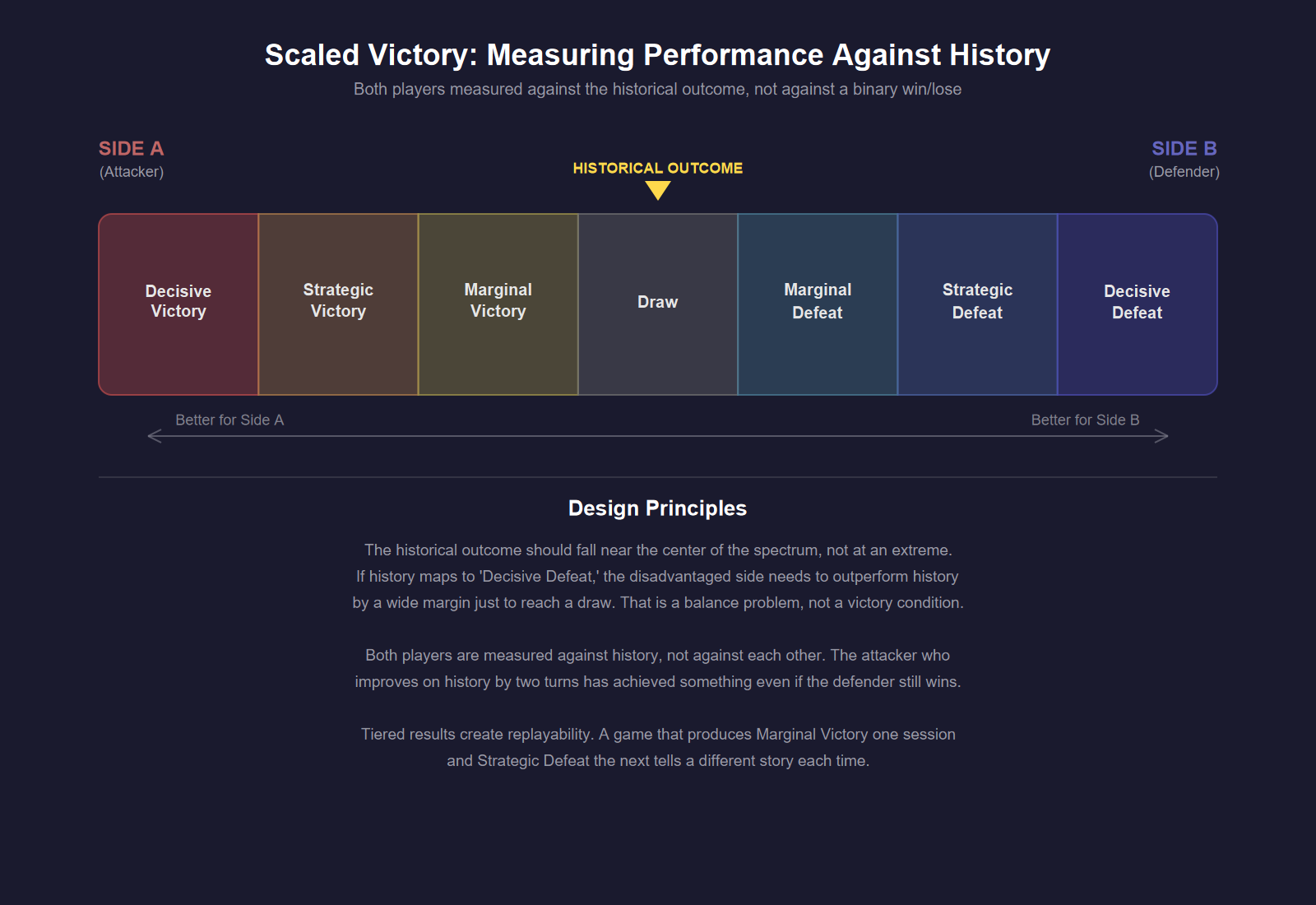
Most real conflicts did not end in total victory or total defeat. The results fell on a spectrum, and scaling your victory conditions to match that spectrum adds granularity that a binary win/lose structure cannot provide.
A typical scaled system uses four or five tiers: decisive victory, strategic victory, marginal victory, draw, and marginal defeat (with the inverse for the other player). Each tier corresponds to a range of VP totals or a combination of territorial and point conditions. A decisive victory represents the best plausible outcome for that side. A marginal victory represents a modest improvement over the historical result. A draw represents roughly the historical outcome. A marginal defeat is worse than history but not catastrophic.
This structure does several things at once. It gives the losing side something to play for. Even if the French player in a Franco-Prussian War game cannot win outright, they can aim for a marginal defeat instead of a catastrophic one, and the difference between those outcomes should feel meaningful. It creates historical insight by showing the player how close the actual result was to alternative outcomes. And it produces replayability because the game generates different narratives depending on whether the result lands at the top or bottom of the spectrum.
The key to scaled victory is calibrating the tiers against the historical record. The historical outcome should fall somewhere in the middle of the range, not at one extreme. If the historical result maps to a “decisive defeat” for one side, the designer has created a game where that side needs to outperform history by a wide margin just to reach a draw. That is a balance problem disguised as a victory condition problem.
Designing for Lopsided History
Some conflicts were so one-sided that the historical loser had no realistic path to victory. Sedan 1870 is one of these. The French army was strategically outmaneuvered before the battle began. MacMahon marched into a trap. The Prussians surrounded Sedan and bombarded the French into submission. Napoleon III surrendered with over 100,000 troops. As a military engagement, the outcome was close to predetermined.
I designed a game on this battle, We Were Not Cowards: Sedan 1870, published in the Imperial Bayonets series. The design problem was immediate. If the victory conditions required the French player to win the battle, nobody would play the French. If the victory conditions were so generous that the French won half the time, the game would lie about what happened. Both options fail.
The solution is to reframe what victory means for the disadvantaged side. The French at Sedan could not win the battle. But they could have fought better. They could have inflicted more casualties on the Prussians. They could have held longer. They could have organized a breakout attempt that, even if it failed, would have preserved more of the army than capitulation did. The French player in my game is not trying to defeat the Prussian army. They are trying to perform better than MacMahon did, which is a lower bar but still a meaningful one.
Scaled victory is essential for these situations. The French player is aiming for a marginal defeat instead of the historical catastrophe. The Prussian player is trying to match or exceed the historical result. Both players have something to play for because both players are measured against history rather than against an abstract win/lose binary. The French player who holds out two turns longer than MacMahon did and inflicts 30% more casualties has achieved something worth achieving, even though the French army still surrenders at the end.
This approach teaches the player something about the conflict that a binary result cannot. It answers the question “could the French have done better?” and lets the player explore how. Wargames are the only medium that lets you inhabit a historical decision space and test alternatives against the same constraints the real commanders faced. Victory conditions are where you build the door into that space.
Victory Conditions and Alternate History
Good victory conditions create alternate history as a byproduct of play. They do not force it. If the Allied player in a D-Day game secures the beachhead by turn 4 and breaks out by turn 8, they have created an alternate history where the Normandy campaign went faster than it did. They did not set out to create alternate history. They set out to win the game, and the victory conditions guided them toward decisions that produced a plausible alternative to what happened.
This is different from a game that instructs the player to “explore what-if scenarios.” The what-if emerges from the interaction between the player’s decisions and the game’s systems. Victory conditions establish the framework. The player fills it in.
When you are designing victory conditions, ask yourself: if a skilled player achieves a decisive victory, does the resulting narrative make historical sense? If the German player captures Moscow in a Barbarossa game, is the path they took to get there plausible? Did they have to solve the same problems the historical commanders faced, or did the victory conditions let them bypass those problems? If the path to victory requires historically unrealistic behavior, your victory conditions need work.
Connecting Victory to Your Systems
Victory conditions interact with every system in your game. The CRT determines how fast territory changes hands and how fast casualties accumulate. The supply system determines which advances are sustainable. The morale system determines when an army collapses. The sequence of play determines how much the players can accomplish in a turn.
If your victory conditions require the attacker to capture a city by turn 6, the movement rates and combat results need to make that achievable but uncertain. If the math says the attacker cannot possibly reach the city before turn 8, the victory condition is broken regardless of how historically correct it is. If the math says the attacker reaches the city on turn 3 without serious opposition, the victory condition is too generous.
Playtesting (covered in Chapter 16) is where you calibrate this. Run the game multiple times and track where the final VP totals land relative to your scaled tiers. If the results cluster at one extreme, either the systems or the victory conditions need adjustment. The goal is a spread of results centered roughly on the historical outcome, with decisive results in either direction possible but uncommon.
Case Study: Rostov ‘41 and the SCS Victory Structure
Rostov ‘41, my design for MMP’s Standard Combat Series, covers the first German drive on Rostov-on-Don in November 1941 and the Soviet counteroffensive that retook the city, the first time the Wehrmacht was forced to give up a major objective on the Eastern Front.
The SCS uses a straightforward VP system. Players earn VP for controlling specific hexes at the end of the game. The challenge was that the historical outcome was a German failure. The Germans took Rostov on November 21 and were driven out by November 29. If I set the victory conditions to reward the German player for holding Rostov, the game would punish historical play. If I set them to reward the Soviet player for retaking Rostov, the German player would have no reason to take it in the first place.
The solution was scaled territorial victory tied to the timing of control. The German player earns VP for every turn they hold Rostov and for territorial gains east of their start line. The Soviet player earns VP for retaking Rostov and for the speed of the recapture. Both players have objectives that pull in different directions. The German player wants to grab territory and hold it as long as possible. The Soviet player wants to conserve strength in the early turns and then counterattack at the right moment. The historical outcome, German capture followed by Soviet recapture, produces a result in the middle of the VP range. A German player who holds Rostov for two extra turns improves their position. A Soviet player who retakes it a turn early improves theirs.
The VP structure also had to account for the broader operational context. The German drive on Rostov was part of Army Group South’s autumn offensive. The Soviet counteroffensive was Timoshenko’s first successful large-scale operation. The VP awards reflect these stakes: Rostov itself is worth points, but the overall territorial balance matters too. A German player who takes Rostov but loses ground everywhere else has won a battle and lost a campaign.
This is the kind of design problem victory conditions present. The history gives you the parameters. The scaled VP system lets you create a game where both players are trying to outperform history, where the historical outcome is a plausible result rather than a guaranteed one, and where the VP tiers map to historically meaningful differences in performance.
Summary
Victory conditions belong at the start of the design process, not the end. They define what every other system needs to accomplish. Build them from the historical record. Scale them to create a spectrum of outcomes rather than a binary win/lose. Give the disadvantaged side something meaningful to play for. Connect them to your systems so that the path to victory requires historically plausible behavior. Test them through repeated play to verify that the results cluster around the historical outcome with room for both sides to improve on it.
The best victory conditions teach the player something about the conflict. They answer the question “what would it have taken to change the outcome?” and let the player test their answer against a system built from the same constraints the real commanders faced.