❖ Turn 10
We will first head towards the warrd of the salt quarter - taking some pamphlets with me, I instruct the others to prostletyze and help the needy in the meantime.
Scene Five: The Ward of the Salt Quarter — Late Morning
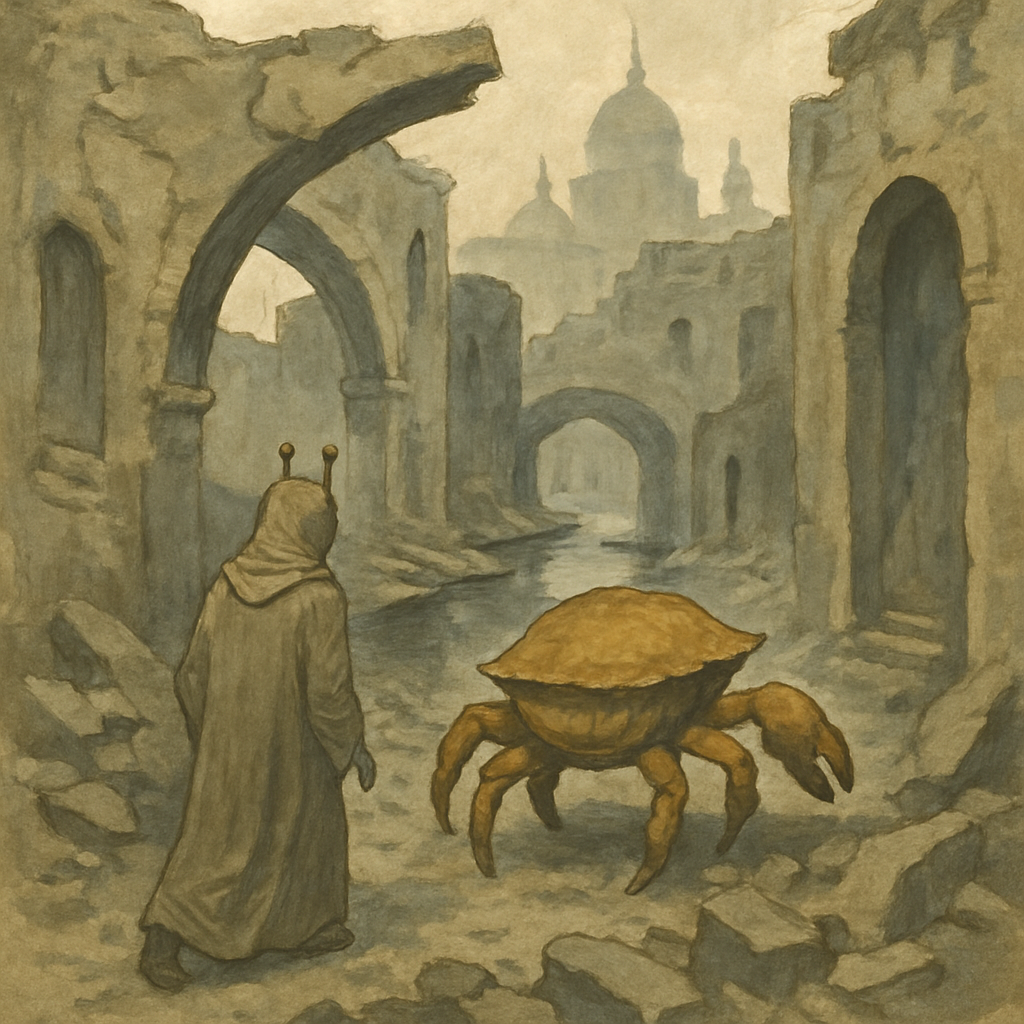
You turn back to the cell before you go. Eleven people in a grain-store, blinking in the canal-quarter morning. You speak plainly.
“Selindi runs the house while I’m gone. Hamech learns the protocols today — all of them. The six pamphlets I’m leaving: distribute them by hand, to people you know personally, not strangers. If anyone needs food or a clean wound dressed or someone to carry a message to family, we do that first. The word means nothing if it floats above people’s actual lives.”
You divide the pamphlets — six on your person, six left with Selindi, who tucks them with the quiet efficiency of a woman who has hidden things before. Dov nods. Pav is already asking Hamech something in a low voice. Tuket, at the door, meets your eyes and says nothing, which from her is a kind of blessing.
Krah-Moh is already outside.
The route south takes you through the merchant quarter’s fringes and then down along the God River’s western bank, where the city thins and the smell changes — from spice and sewage to salt and river mud and something older underneath, the particular rot of a place that was once inhabited and is now only almost inhabited. Old Town begins as a feeling before it begins as a place: the yellow stones growing closer together, the streets narrowing into paths, the paths narrowing into gaps between collapsed walls choked with creeper vine.
RANDOM ENCOUNTER — Old Town approach
d6 → 2   Nothing immediate. But the city watches.
No trouble on the road. But the city watches. A group of ulufo children scatter around a corner ahead of you — cockroach-herders, their long switches dragging. Two human men moving north along the river path give Krah-Moh a long look and say nothing. A slug-man in plain robes in this quarter at this hour is unusual enough that people are making calculations.
Krah-Moh navigates without hesitation. He takes a left before you would have, threads between two half-collapsed archways you’d have walked past, and brings you out onto a wider ruin-path running south along the river. He has been here before. You file that away.
        ┌─────────────────────────────────────┐
        │  OLD TOWN — WARD OF THE SALT SHORE  │
        │                                     │
        │  ≈≈≈ GOD RIVER ≈≈≈≈≈≈≈≈≈≈≈≈≈≈≈      │
        │  ┌────┐  rubble  ┌───┐             │
        │  │    │~~~~~~~~~~│   │  ← ruins    │
        │  └────┘  path    └───┘             │
        │       ↓                            │
        │  [SALT FLATS EDGE] ←tidal mark     │
        │  cracked shells · yellow flowers   │
        └─────────────────────────────────────┘
The Ward of the Salt Quarter is not a ward anymore — the name is what the survivors kept, after the quarter itself was broken. What remains is a fringe of low collapsed buildings pressed between the river-path and the tidal flats, where the God River widens and slows before meeting the sea. At low tide, the flats expose a hundred yards of grey-brown mud and salt crystal. At high tide, the water comes up to the ruin-line.
It is low tide now. The flats stretch south, shimmering faintly in the late-morning heat. And at the tidal mark — the precise line where the highest water reaches — you see them.
Cracked shells. Yellow flowers. A dozen small arrangements, spaced ten feet apart along the mark, as regular as a sentence. Some are fresh — the flowers still holding color. Some are old — bleached petals, shell-fragments ground to powder by the tide’s return. The line runs along the ruin-edge for perhaps forty yards.
WIS check — read the offerings, understand their pattern
Heretic-Scholar applies (ritual literacy is scholarship)
Positive double roll, WIS 15
2d20 → 11 and 4 — take the 11
11 ≤ 15 — SUCCESS   Quality: 11
You crouch at the nearest arrangement. The shells are not random — they’re crab shells, specifically the ventral plates of the smaller tidal variety, placed cupped-side up. The flowers are yellow marigold-analogues, the kind that grow in the rubble of Old Town. And each arrangement has been placed with the shells forming a loose circle around the flowers, not a pile — a congregation. A gathering, rendered in material. Twenty-two years of people coming to this waterline and saying, in a language that requires no literacy: we are still here. We are still waiting.
Krah-Moh has stopped three paces behind you. He is looking at the offerings line. Then he does something you have not seen him do before: he lowers himself — both claws, both knees — and touches the mud at the tidal mark with the flat of one claw. Holds it there. Rises.
He knew this place. He has been here before. Perhaps many times.
The sound of the flats: wind off the river, salt-crust cracking underfoot, somewhere in the ruins behind you the tap of something — a walking stick on stone.
You turn.
An old crab-man sits in the shadow of a half-collapsed arch twenty feet back along the ruin-path, nearly invisible in the dim. His shell is deep red-brown, ancient, worn smooth at the edges the way very old shells go. He is small — smaller than Krah-Moh — and still in the particular way of someone who has learned that stillness is the price of continuing to be here. He is watching you with compound eyes that have seen twenty-two years of the tidal mark.
He does not move. He does not flee.
Between you and him, Krah-Moh has gone completely motionless.
REACTION ROLL — old crab-man
2d6 → 8   Neutral; willing to be approached carefully
The old crab-man waits. The wind moves across the flats. The salt crystals catch the light.
You have pamphlets. You have Krah-Moh, who speaks this being’s language in a way you cannot. You have a name — Cheth-of-the-Salt-Shore — and the question of what happened to it. And you have a slug-man’s face, which in this ward, twenty-two years after what the Oligarchy called a Disturbance, is a complicated thing to be wearing.
What do you do?
◆ Vothrog HP 4/4 · Ward of the Salt Shore, Old Town · Old crab-man in the archway; Krah-Moh motionless; tidal offerings; the name is close
← Turn 09 · ↑ All turns · Turn 11 →