❖ Turn 9
Ask more about Cheth himself if anything is known - after gathering whatever information I can - I’ll take krah-moh with me and go to either a library/archive to see if I can research more information about the event itself if I am completely unaware of it.
Scene Four: The Canal Quarter — Questions Before Departure
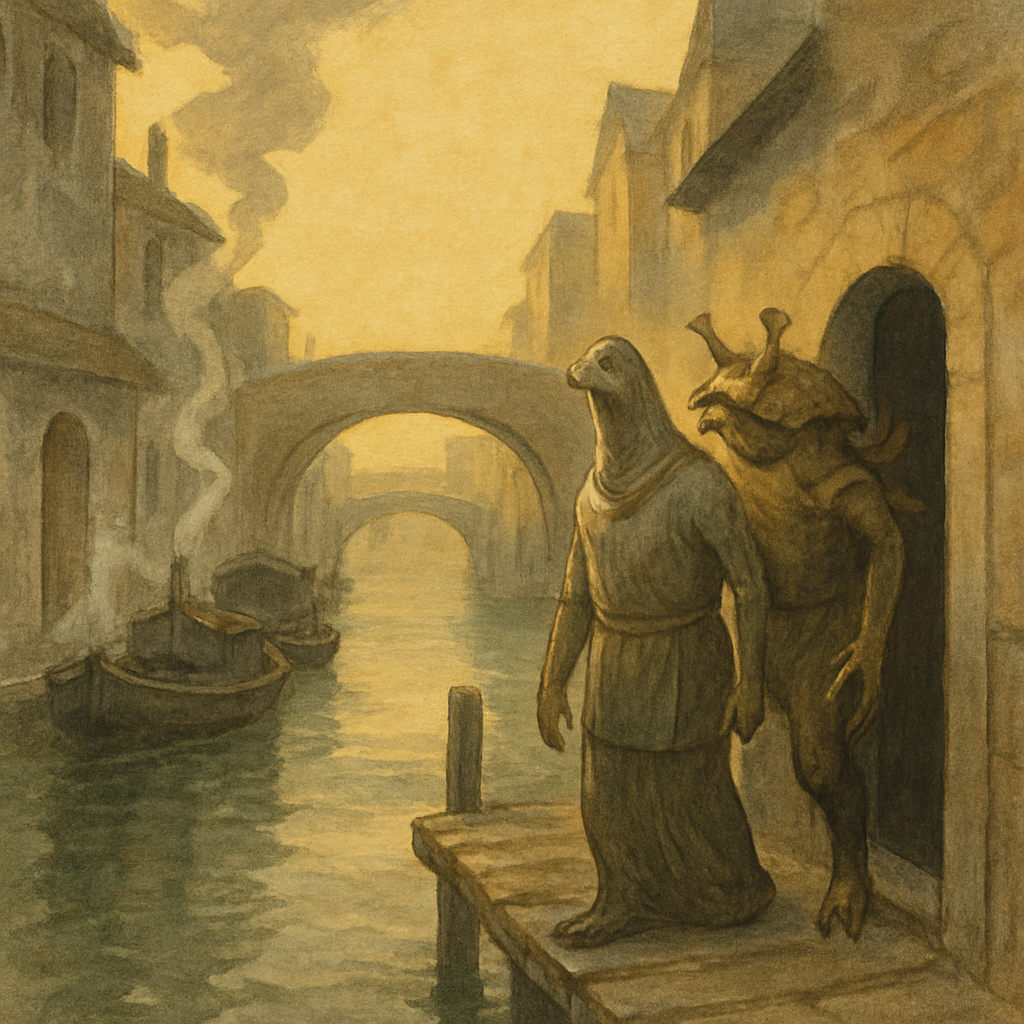
You pull your stool closer to Tuket and lean forward, elbows on knees, the posture of someone who is genuinely listening rather than waiting to speak.
“Tell me about Cheth himself. Not the event — the being. What do people say he was?”
Tuket is quiet for a moment, working something over in her memory. The canal light moves on the ceiling.
KNOWLEDGE ROLL — depth of what Tuket & Selindi know about Cheth specifically
Tuket: d6 → 5 — significant personal memory
Selindi: d6 → 4 — textual/historical fragments
“The salt-shore workers called him the First Freed One,” Tuket says. “The story goes — and I am giving you story, mind, not history — that Cheth was a crab-man who had been a house-slave since the shell. Not Yellow City. Somewhere north. He escaped. Made his way down the God River on a reed barge. Arrived at the salt-shore with nothing, took work in the tidal flats alongside the free crab-men who rendered sea-salt there.” She pauses. “The tidal flat workers are not slaves. But they are not free either. They are bound to the flats by debt — the slug-lords advance them tools and housing and collect in perpetuity. A different collar.”
“Cheth began to speak,” she continues. “Not in Common. In the crab-men’s own language. The clicking and posture-speech they use among themselves. He spoke, and the workers listened, and after a while the human salt-shore laborers — the debt-workers who render the coarser grades — began asking what he was saying, and the crab-men would tell them, and then they too would gather.”
A beat.
“They say he claimed the divine spark resided in the shell as much as in the flesh, and that a being who had been made property could not have been made property by any god worth the name. That the slug-lords’ heaven was a story the slug-lords told to justify the slug-lords’ earth.”
She looks at you with something complicated.
“You understand why I am looking at you this way.”
“I do,” you say.
Selindi speaks from across the room, not looking up from her folded hands: “The historical record — such as it is, and it is thin, because the slug-lords’ archives do not tend to preserve what they prefer to have not happened — calls it the Salt Shore Disturbance. Three days. The twenty-second year of the current Oligarchy. The Watch and a company of hired blades went in on the second morning. The official report says eleven dead and the agitators dispersed.”
“Agitators,” Dov says. It is not a question.
“Eleven is a small number for three days of something,” Pav says quietly.
“Yes,” Selindi says. “It is.”
“And Cheth?” you press.
Selindi shakes her head. “The record does not mention him by name. He is — absent from the official text. Which is itself a kind of information.”
Tuket speaks again, voice lower now. “The salt-shore workers say he was taken. Not killed in the fighting. Taken — specific, deliberate, by men who knew who they were looking for. After the Disturbance the crab-men on the flats left offerings at the tidal mark. Not mourning offerings. Waiting offerings.” She meets your eyes. “You understand the distinction.”
You sit with that for a moment. Taken. Twenty-two years ago. The official record erased him. The workers still leave offerings on dark moons.
You look at Krah-Moh.
He has not moved since Tuket began speaking. But his posture has changed — something in the angle of the great ochre shell, something in how his claws rest. You have spent enough time near him now to recognize this is not stillness. It is the quality of attention a person gives to something they already know and are hearing said aloud for the first time by someone who also knows it.
“Do you know the salt-shore?” you ask him directly.
He cannot answer in words. But his compound eyes move — once, slowly — to Tuket. Then back to you.
“The archive,” Selindi says, before you can speak again. She is practical in the way people who have kept records under oppression learn to be. “If you want more than memory and rumor — and you should want more — there are two places worth trying.” She produces a small folio from somewhere in her robe and writes quickly. “The Cartulary of the Three Bells — a private archive in the merchant quarter, ostensibly a guild records house, actually holds a great deal that the Oligarchy’s public archive has quietly excised over the decades. They are not sympathizers. But they are archivists, and archivists hate erasure almost on principle.”
“The other?”
“The Old Town ruins, Ward of the Salt Quarter — not a library. But twenty-two years is not so long. There are people still living in the margins of Old Town who were there. The kind of people the official record also forgot to mention.”
She tears the folio page and hands it to you.
LEADS WRITTEN DOWN
───────────────────────────────────────────────────
1. Cartulary of the Three Bells — merchant quarter
   Private archive, guild records front.
   Holds excised material. Not friends, but archivists.

2. Salt Shore, Old Town ruins — Ward of Salt Quarter
   Living witnesses. People the record forgot.
   Harder to find. Harder to predict.
───────────────────────────────────────────────────
You stand. Krah-Moh rises the moment you do — no hesitation, no waiting to be told — and takes his position at your left shoulder.
The cell watches you. Selindi gives you a look that says bring back something usable. Tuket says nothing, but she touches her chest once, briefly, in the manner of the low-caste blessing — a gesture she learned somewhere she doesn’t explain.
Hamech, from his corner, says: “Will you come back tonight?”
“Tonight or word before it,” you say. “Selindi knows the protocols.”
The canal door opens onto yellow morning. The city breathes around you, indifferent and alive.
ASSETS UPDATED
────────────────────────────────────────────────────────
Cheth profile:
  • Formerly enslaved crab-man, escaped; arrived at
    tidal salt-shore flats south of Old Town
  • Preached divine spark in crab-men's own tongue;
    drew human debt-workers too
  • Claimed: a being made property cannot have been
    made so by any god worth the name
  • Salt Shore Disturbance — Year 22 of current
    Oligarchy (~22 years ago). 3 days. 11 official dead.
  • Cheth: absent from official record. Taken, not
    killed. Waiting offerings still left at tidal mark.
  • Krah-Moh's reaction: recognition. He knows this.

Leads:
  A. Cartulary of the Three Bells — merchant quarter
  B. Old Town, Ward of the Salt Quarter — witnesses

Cell: intact; Selindi managing; Hamech oriented
Pamphlets ×12 on person · Coin 76 gp · HP 4/4
────────────────────────────────────────────────────────
The merchant quarter is north and uphill — an hour’s walk, formal, requiring you to look like what you technically are. The salt-shore ruins are south along the river — closer in distance, further in respectability, and Krah-Moh beside you will read differently in Old Town than in a guild archive.
Which do you go to first — the Cartulary of the Three Bells, or the Ward of the Salt Quarter?
◆ Vothrog HP 4/4 · Yellow City, Canal Quarter — departing · Two leads; Krah-Moh at your side; Cheth was taken, not killed; workers still wait
← Turn 08 · ↑ All turns · Turn 10 →